

Thinking about doing your Master’s in Psychology from one of the top central universities in India? Jamia Millia Islamia’s M.A. Applied Psychology program is one of the most sought-after courses for psychology aspirants across the country.
In this blog, you’ll find everything you need to know about the program — from eligibility and entrance exam syllabus to seat details, reservations, fees, and last year’s cut-offs. If you’re planning to apply to Jamia in 2025, this guide will help you get started the right way.
Let’s dive in!

MA Applied Psychology Program at JMI, New Delhi
About Jamia Millia Islamia (JMI)
Jamia Millia Islamia, a Central University established in 1920, stands as a premier institution known for its commitment to inclusive and quality education. It was declared a Central University by an Act of Parliament in 1988. Ranked 3rd among all Indian universities by NIRF and accredited with NAAC Grade A++, Jamia offers state-of-the-art academic and research infrastructure, student diversity, and a rich intellectual culture.
With over 239 acres of campus area and globally recognized research output, Jamia Millia Islamia blends traditional values with modern innovation. It is home to distinguished faculty members, international collaborations, and vibrant student life.



About the M.A. Applied Psychology Program
The Department of Psychology at JMI became an independent department in 1986. It began offering the M.A. in Applied Psychology in 1989, and has since grown into a well-established academic and research hub with focus areas including Work and Organizational Psychology, Social Psychology, Mental Health and Counseling.
The program draws applicants from across India and abroad, thanks to its well-rounded curriculum, strong faculty, and excellent academic resources.
Program Overview
- Program Name: M.A. (Applied Psychology)
- Duration: 2 Years (4 Semesters)
- Program Code: M15
- Seats: 42 Total Seats
- Eligibility Criteria:
- Option 1: B.A. (Hons.) in Psychology with at least 50% marks
- Option 2: B.A./B.Sc./B.Com./BBA or equivalent with at least 55% aggregate marks
Cut-Off Marks (Previous Year)
Here’s a snapshot of the 2024 Cut-off Marks for various categories in the MA Applied Psychology entrance exam:

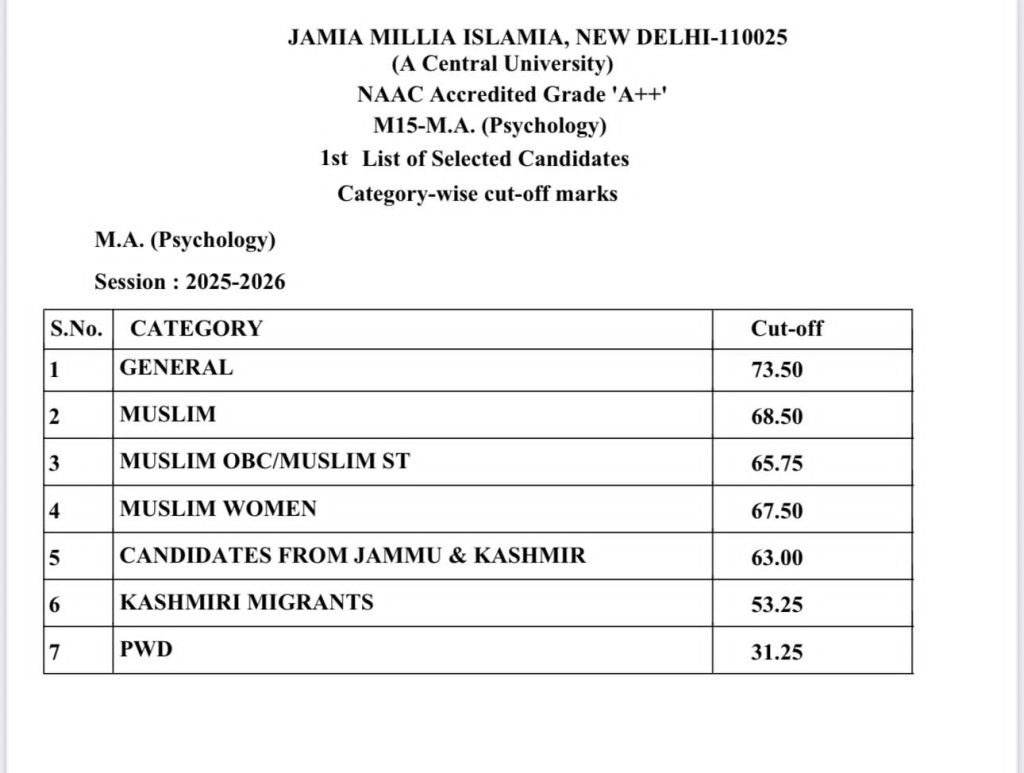
Cut-Off Marks (2025-26)
Entrance Test Details (2025)
- Mode: Offline
- Duration: 90 Minutes
- Total Questions: 100 MCQs
- Marking Scheme: +1 for correct, -0.25 for incorrect answers
- Weightage:
- Psychology: 80%
- General Awareness: 20%
Indicative Syllabus for the Psychology Part (80% Weightage)
- GENERAL PSYCHOLOGY: Basic psychological concepts like Sensation, Perception, Motivation, Learning, Memory, Cognition, Intelligence, Emotions.
- SOCIAL PSYCHOLOGY: Basic Social Psychology concepts like Attitude, Prejudice, Discrimination, Social Influence, Group Norms, Inter Personal Attraction.
- HEALTH PSYCHOLOGY: Stress, Health Models, Pain Management.
- PHYSIOLOGICAL PSYCHOLOGY (Biological Bases): Nervous system, Visual system, Hearing, Somatosenses, Sleep Disorders.
- ABNORMAL PSYCHOLOGY: Paradigms of abnormal behaviour, psychological disorders based on DSM-5TR.
- ORGANISATIONAL BEHAVIOUR: Motivation, Job Satisfaction, Stress, Leadership, Organisational structure.
- RESEARCH METHODOLOGY & STATISTICS: Research designs, sampling procedures, measurement and testing, descriptive, inferential, hypothesis testing, parametric and non-parametric.
- CHILD DEVELOPMENT: Developmental theories, biological foundations, factors affecting growth during infancy and childhood.
Admission Timeline (Tentative)- Online Forms Available: From March 5, 2025
- Last Date to Apply: April 10, 2025
- Form Editing Window: April 12–14, 2025
- Admit Cards Release: From April 17, 2025
- Entrance Test Date: May 25, 2025
- Result Declaration: Within 20–25 days post exam


Previous Year Questions for JMI 2024
1. Which neurotransmitter is believed to play a significant role in both schizophrenia and Parkinson’s disease?
a. Dopamine
b. Serotonin
c. Acetylcholine
d. Norepinephrine
2. According to Alfred Adler, helplessness of the infant accounts for:
a. Feelings of inferiority
b. Compensatory strivings
c. A need to strive for superiority
d. All of these
3. Fixed false belief based on incorrect inferences about external reality is called:
a. Delusion
b. Obsession
c. Overvalued Idea
d. Phobia
4. According to Hersey and Blanchard’s situational leadership theory, what should a leader do when followers have high readiness levels?
a. Provide clear instructions and closely supervise tasks
b. Delegate tasks and decision-making authority
c. Offer rewards and punishments based on performance
d. Adopt a supportive and participative leadership style
5. The Transtheoretical Model of Change proposes that behaviour change occurs in which sequence of stages?
a. Precontemplation, contemplation, action, maintenance, relapse
b. Precontemplation, action, contemplation, maintenance, relapse
c. Contemplation, precontemplation, action, maintenance, relapse
d. Action, contemplation, precontemplation, maintenance, relapse
Answers & Explanations:
1. Ans. a
Sol. Dopamine is increased in schizophrenia (linked to psychosis) and depleted in Parkinson’s disease (causing motor symptoms like tremors and rigidity).
2. Ans. d
Sol. Adler believed infantile helplessness leads to inferiority, which drives compensation and a striving for superiority— core elements of his theory.
3. Ans. a
Sol. A delusion is a fixed, false belief that is not influenced by logical reasoning or contrary evidence, common in psychotic disorders.
4. Ans. b
Sol. When followers are capable and confident (high readiness), leaders should delegate responsibilities, offering autonomy.
5. Ans. a
Sol. The correct sequence is: Precontemplation → Contemplation → Action → Maintenance → Relapse. This model explains stages of behavioural change over time.






Leave a Reply