
University of Delhi
The Department of Psychology at Delhi University was established as an independent department in the year 1964 under the headship of Late Prof. H.C. Ganguli. Prior to that, Psychology at the Master’s level was introduced in 1957 under the Department of Philosophy and Psychology. The department now has two units: one at the North Campus offering M.A. Psychology and Ph.D. programs, and another at the South Campus established in 1981 offering M.A. in Applied Psychology.
Course Structure and Specializations
Eligibility Criteria for both programs
The University of Delhi (DU) accepts candidates for its CUET PG Psychology program under three specific eligibility categories:
Category 1A includes Bachelor’s Degree in any discipline from a recognized university (no specific subject requirement).
Category 2A is students who have pursued B.A. (Hons.) Psychology or Applied Psychology from University of Delhi.
Category 2B applies to students who have pursued B.A. (Hons.) / B.A. (Prog.) with at least two (02) courses/papers in Psychology / Applied Psychology from University of Delhi.
North Campus: M.A. Psychology
- Duration: 2 years (4 semesters)
- Curriculum Highlights:
- Core papers: Cognitive Processes, Research Methods, Social Psychology, Conceptual History, Practicals
- Specializations: Clinical Psychology, Organizational Psychology, Community Mental Health, Positive Psychology
- Open electives: Gender and Psychology, Psychology of Disability, Field Training,etc
- Research Focus: Emphasis on both quantitative and qualitative research, with opportunities for empirical studies and theoretical exploration.
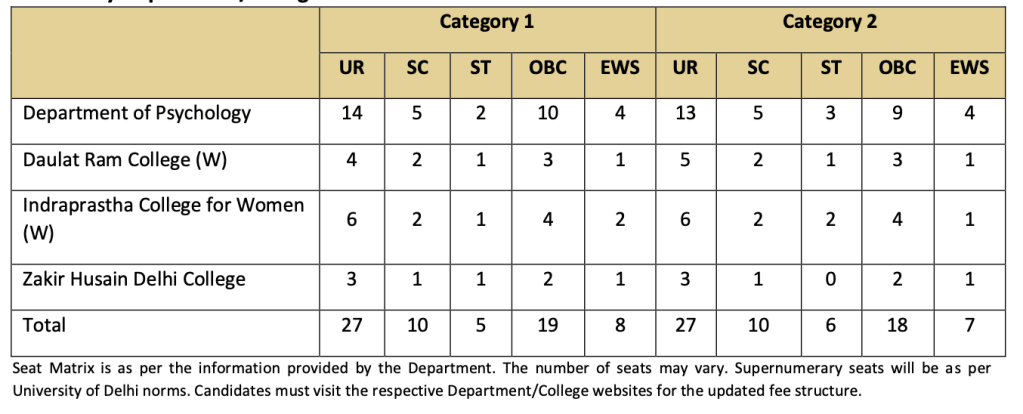
- Seat Matrix: 137 (as per 2025 Information Bulletin)
Number of Seats offered by Department/Colleges in North Campus
| Core Subjects | Focus | Practical Components |
|---|---|---|
| Semester 1: Applied Psychometry, Qualitative Methods–I, Cognitive Processes, Social ,Emotions, Selfhood, Paradigms,Research Method & Stats | Research & Foundations | Practicums based on selected theory papers |
| Semester 2: Continuation of Specialization + Advanced Electives | Applied Psychology Areas | Practicums based on selected theory papers |
| Semester 3: Choose 1 Specialization : Clinical Psychology Organizational Psychology Indian Psychology | Begin Specialization | Internship / Field Work (50 days) is compulsory |
| Semester 4: Continuation of Specialization + Advanced Electives | Deeper focus within chosen specialization | Dissertation is compulsory |



South Campus: M.A. Applied Psychology
- Duration: 2 years
- Curriculum Highlights:
- Application of psychological principles to real-world problems
- Practical exposure and fieldwork integral to the program
- Prepares students for roles in counseling, mental health, and organizational settings
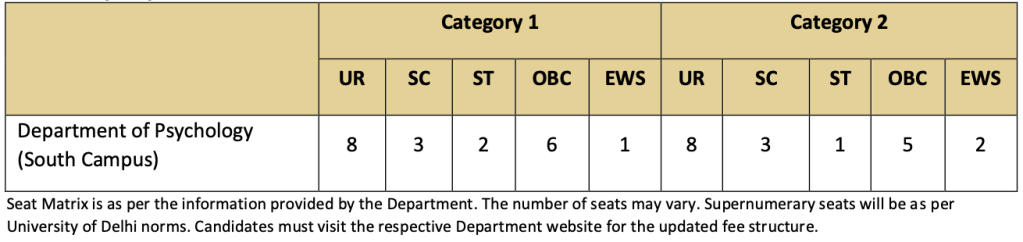
- Seat Matrix: 39 (as per 2025).
- Key Campus/College:
- Department of Psychology, South Campus (SDC)
Number of Seats offered by Department/Colleges in South Campus
| Core subjects | Practical Components |
| Semester 1: Cognitive PsychologyResearch MethodsCommunity Psychology | Practicum based on core papers |
| Semester 2: Psychological AssessmentClinical & Health PsychologySocial Psychology | Practicum (Core + Optional) |
| Semester 3: Choose 1 Specialization: Clinical & Health Organizational Social Psychology | Practicum + Field Training (Internship) |
| Semester 4: Advanced papers from chosen specialization | Dissertation + Viva |
North Campus vs. South Campus
| Features | North Campus (MA Psychology) | South Campus (MA Applied Psychology) |
|---|---|---|
| Course Offered | M.A. Psychology (General & Research Focused) | M.A. Applied Psychology (Application & Specialization) |
| Academic Focus | Theoretical foundation, research, general psychology | Application of psychology in real-world settings |
| Specializations | Clinical, Indian, Organizational ,Health | Specializations offered: Clinical and Health, Social, Organizational Psychology |
| Career Orientation | Prepares for research, academia, broad psychology roles. | Trains for professional roles in hospitals, organizations, counseling, advertising, etc. |
Academic Excellence
The academic environment here is rigorous, with a strong research culture — students and faculty are actively involved in national and international research projects, and there’s a steady output of research publications. The campus regularly hosts seminars, conferences, and workshops, providing students with exposure to advanced academic discussions and networking opportunities.
South Campus, while slightly newer, is also home to reputed institutions such as Lady Shri Ram College (LSR), Sri Venkateswara College, and Gargi College. South Campus is praised for its inclusive and diverse atmosphere, modern facilities, and practical learning opportunities, making it ideal for students who value a balanced and supportive academic environment.
Campus Amenities
North Campus offers key amenities including an affordable cafeteria near the Central Library, a Co-operative Store for daily essentials, and a DTC Bus Pass section for subsidized travel. It also has a Post Office, Railway Reservation Counter, and banks (SBI & ICICI) for financial services. The WUS Health Centre provides medical care, while Gandhi Bhawan hosts events on Gandhian values. The University Press handles printing, and guest houses accommodate official visitors.
South Campus provides a Health Centre for medical services, on-campus banks, and a Post Office with postal services. The DTC Pass section offers bus pass services, and faculty/staff housing is available. Student accommodations include Geetanjali Hostel (women), Saramati Hostel (men), and Aravalli P.G. Hostel (men).
A Legacy of Excellence | Choose your Dream College with PWP


Campus Life
North Campus
When it comes to college festivals, North Campus is the best. Events like the Hindu College Fest, Miranda House Fest, and SRCC Fest are famous—full of popular performers, big crowds, and a fun party atmosphere.
The hangout spots are just as lively. Kamla Nagar Market is a great place for cheap food and shopping, while Hudson Lane has cozy cafes that are perfect for late-night chats over tea. Don’t forget to visit Majnu Ka Tila, a hidden gem with tasty Tibetan food and a unique market feel
South Campus
South Campus festivals, like the ones at Lady Shri Ram College and Venkatraman College, have their own special vibe. They feel more personal and well-planned, with a classy touch. You might find live jazz music, art shows, or exciting dance battles — more than just big crowds and noise.
For relaxing, Hauz Khas Village is a favorite hangout. It has cafes by the lake, small unique shops, and rooftop bars with great views. Dilli Haat is where you can enjoy food and culture from different parts of India. And if you just want some peace and quiet, Deer Park is a lovely green space to chill under the trees.
Commuting
North Campus is easily accessible via the Yellow Line metro, linking it to city hotspots like Connaught Place. It’s convenient for those relying on public transport.
South Campus, on the other hand, is served by the Pink and Magenta lines. With less traffic congestion, driving is more relaxed, making commuting smoother for those with cars or bikes.

“The Department of Psychology, North Campus University of Delhi, in collaboration with GAIL Training Institute (GTI), successfully organized an enriching organizational visit for our students in OB specialization on 7th of Feb, 2025… Students had the opportunity to engage with experts, gain hands‑on exposure, and deepen their understanding of organizational dynamics.”
GAIL TRAINING INSTITUTE, FIELD VISIT (Click here for Details)
Final Thoughts
Both campuses offer excellent education and career opportunities. Your decision should be based on your interests — research and theory (North Campus) or applied and professional practice (South Campus). Both have experienced faculty, strong industry links, and a supportive learning environment. Choose the one that best matches your career goals and personal preferences.


Leave a Reply