What Even Are Emotions — and Why Do They Matter So Much?
Emotions aren’t just feelings — they’re your brain’s way of saying, “Pay attention!” That exam panic? That random spiral after a meme? – are all signals.
When emotions stick around, they turn into moods. When moods mess with your life, it could be something deeper like a mental health conditions.
Basically, emotions are self-defense in this rollercoaster we call life.
Let’s see which parts of our body are involved when emotions arise.
1. Brain — The Control Room
Amygdala: This almond-shaped structure in the brain is like your emotional smoke alarm. It detects threats and triggers quick emotional responses like fear or anger.
Prefrontal Cortex: It helps you think things through. It’s where reasoning and regulation kick in — like calming yourself down after a scare.
Hippocampus: Links emotion to memory. That’s why emotions can make memories more vivid.
Hypothalamus: Regulates hormones and links the nervous system to the endocrine system — it helps trigger the body’s fight-or-flight response.
2. Autonomic Nervous System — The Body’s Accelerator and Brake
This system controls involuntary responses. It has two parts:
Sympathetic Nervous System (SNS): Gets you hyped up — increases heart rate, dilates pupils, tenses muscles (fight or flight).
Parasympathetic Nervous System (PNS): Calms you down after the emotion — slows heartbeat, lowers blood pressure (rest and digest).
3. Hormonal System — The Chemical Messengers
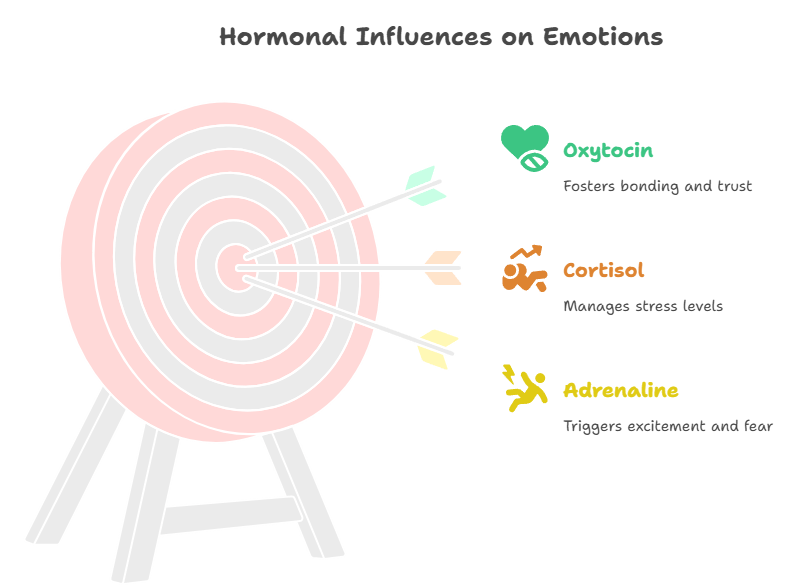
Adrenaline (Epinephrine): Released when you’re scared or excited. Gives you that rush.
Cortisol: The stress hormone. Helps the body stay alert, but too much for too long? Not so great.
Oxytocin: The “bonding” hormone. It rises during affection and trust — like during hugs or holding a baby.
Antecedents of Emotion in Psychology: A Quick Trip Through History
In ancient times, emotion was all about philosophy.
Way before psychology was even a thing, Plato and Aristotle were already debating emotions like it was the OG podcast.
Plato saw emotions as wild, chaotic, and something that needed to be controlled by reason — basically, your heart shouldn’t be in the driver’s seat.
Aristotle, on the other hand, gave emotions more credit. He believed they could be useful tools, as long as we used them wisely — like anger to fight injustice or compassion to build harmony.
So, what do you think — when something happens, what’s the first thing you notice? If you said, “I just felt scared,” then you’re already thinking like the Common Sense Theory! It’s pretty straightforward: First you feel the emotion, and then your body reacts. Like, “That dog barked — I got scared — and then my hands started shaking.” Makes sense, right?
By the 1800s or 19th Century, it was science time — and suddenly, emotions weren’t just felt, they were studied.
Charles Darwin (1872) Wrote “The Expression of the Emotions in Man and Animals“, where he argued that emotions aren’t random — they’re survival tools. Fear helps us escape danger. Anger helps defend territory. And yes, your facial expressions? Pretty much universal.
Then came William James and Carl Lange (Late 1800s), who flipped the script. Their idea?
“We don’t tremble because we’re afraid — we’re afraid because we tremble.” This became the James-Lange Theory: emotions come after physical reactions. Your body reacts first, and your brain catches up with the feeling.
So, this is the Chronological Timeline of Major Emotion Theories-
Core Idea:Emotion is a result of bodily changes. You don’t cry because you’re sad — you feel sad because you cry. According to this theory, the body reacts first, and then your brain interprets it as an emotion.
Example: You see a dog charging at you → Your heart races and you start to run → You feel fear.
Why It Stuck: It was the first theory to link physical response directly with emotional experience.
2. Cannon–Bard Theory (1920s)
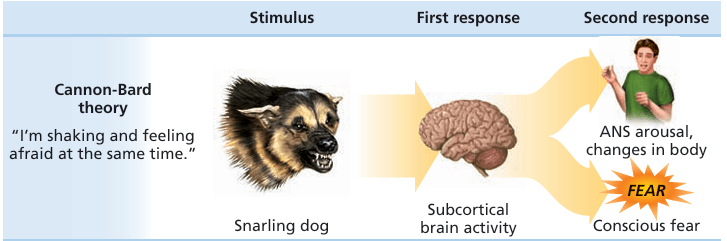
Core Idea:Body and emotion respond together. Cannon and Bard argued that the brain sends signals to the body and the emotional centers at the same time. So, you feel afraid and your body reacts — simultaneously, not one after the other.
Example: You hear a sudden bang → You feel startled and your heart races at the same time.
Why It Matters: It challenged the simplicity of the James-Lange idea and brought in the brain’s central role.
3. Schachter–Singer Two-Factor Theory (1962)
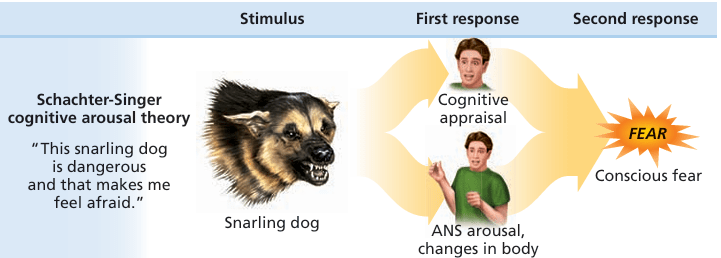
Core Idea:Emotion = Physical Arousal + Cognitive Interpretation. This theory added a mental layer: it’s not enough to feel aroused — your brain also has to interpret the context to label the emotion.
Example: Your heart races in a crowded room. If your crush walks in, you might label it excitement. If someone yells, you might call it fear.
Why It Stuck: It introduced the idea that context and thinking help shape what we feel — emotions aren’t automatic.
4. Cognitive Appraisal Theory (Richard Lazarus, 1966)
Core Idea:Thoughts come before emotions. This theory says it’s not just about the physical or even the label — it’s about how you evaluate the situation. Emotion results from appraisal, or how you make sense of what’s happening.
Example: You fail a test. One person sees it as a personal failure and feels ashamed. Another sees it as a tough paper and feels challenged but calm.
Why It’s Useful: It helps explain individual differences in emotion — people can react emotionally in completely different ways to the same event.
5. Facial Feedback Hypothesis (1970s–1980s)
Core Idea:Expressions influence emotion. Even if you’re not in the mood, forcing a smile might actually make you feel a bit better. This theory suggests that our facial muscles send feedback to the brain that can create or enhance emotional experience.
Example: Holding a smile (even a fake one) for a while may lead to you actually feeling a little happier.
Why It’s Interesting: It suggests that emotion is not just from the inside out, but also from the outside in.
So, emotions aren’t just feelings that randomly show up when life hits hard — they follow patterns, theories, and some serious brain-body teamwork. From trembling first and then freaking out (James-Lange) to slapping on a mental label (Schachter-Singer), psychologists have worked hard to figure out why we feel what we feel. The coolest part? Each theory adds a piece to the puzzle — some focus on the body, some on the brain, and some on that awkward moment when both are doing their own thing. Whether you’re studying for CUET, NET, or just trying to figure out why you cried watching a dog food commercial, understanding emotion theories can help you decode yourself and everyone else. (And maybe pass that psych exam too.)
Which theory states that emotion is the result of physiological arousal followed by interpretation? a. Cannon-Bard Theory b. James-Lange Theory c. Two-Factor Theory d. Appraisal Theory
Who argued that the bodily response and emotional experience occur at the same time? a. William James b. Richard Lazarus c. Cannon and Bard d. Schachter and Singer
The Two-Factor Theory of emotion emphasizes: a. Only bodily arousal b. Only cognition c. Arousal and behavioral feedback d. Arousal and cognitive labeling
In the James-Lange Theory, which comes first? a. Emotion b. Facial expression c. Bodily reaction d. Cognitive appraisal
According to Lazarus’s Cognitive Appraisal Theory, what determines the type of emotion experienced? a. Heart rate b. Muscle tension c. How we evaluate the event d. Hormonal reaction
Which of the following best supports the Facial Feedback Hypothesis? a. Crying leads to sadness b. Smiling can increase feelings of happiness c. All emotions are universal d. Emotion is based only on thoughts
Which theory would explain this: “I feel afraid because I see a snake, my heart races, and I label it as fear”? a. Cannon-Bard b. James-Lange c. Two-Factor Theory d. Facial Feedback
The theory that introduced the role of cognition in emotion was: a. James-Lange b. Cannon-Bard c. Schachter-Singer d. Darwin’s Evolutionary Theory
What was Charles Darwin’s key contribution to emotion theory? a. Emotions are based on memory b. Emotions are culturally created c. Emotions have evolutionary and survival value d. Emotions are learned through conditioning
Which of the following correctly pairs the theory with its main idea? a. Cannon-Bard – Cognitive labelling b. James-Lange – Interpretation before reaction c. Schachter-Singer – Arousal and interpretation d. Lazarus – Emotion causes bodily response
Answer Key
b
c
d
c
c
b
c
c
c
c
Share this article by Power Within Psychology (PWP):
Power Within Psychology is India’s most trusted platform for Psychology entrance exam preparation. As an ISO 9001:2015 certified institution, we offer expert-led coaching, strategic resources, and authentic guidance for CUET PG, UGC NET JRF, GATE, MPhil/MA Clinical Psychology, PsyD, and more.
Through our PWP blogs, we empower aspirants with insights, strategies, and stories that inspire success.










Leave a Reply