

“When you review literature, you’re just checking what others have already said or found about a topic like peeking at a few recipes before cooking. And a hypothesis is just your guess like saying, if people love the sweet brown taste of caramel, they’ll probably enjoy other caramelised foods too.”
Let us understand what Reviewing literature is?
It’s not about reading stories for fun, but about checking what people already know so you don’t start from zero. Usually, you do this after you have chosen your problem, to see what others have said about it, and then you read books, blogs, theses, and research studies on that specific problem.
But what if you are not able to decide on a research problem?
If you can’t decide on a research problem, start with broad reading to get ideas. Once you choose your problem, review again in detail, focusing only on sources related to that exact topic.
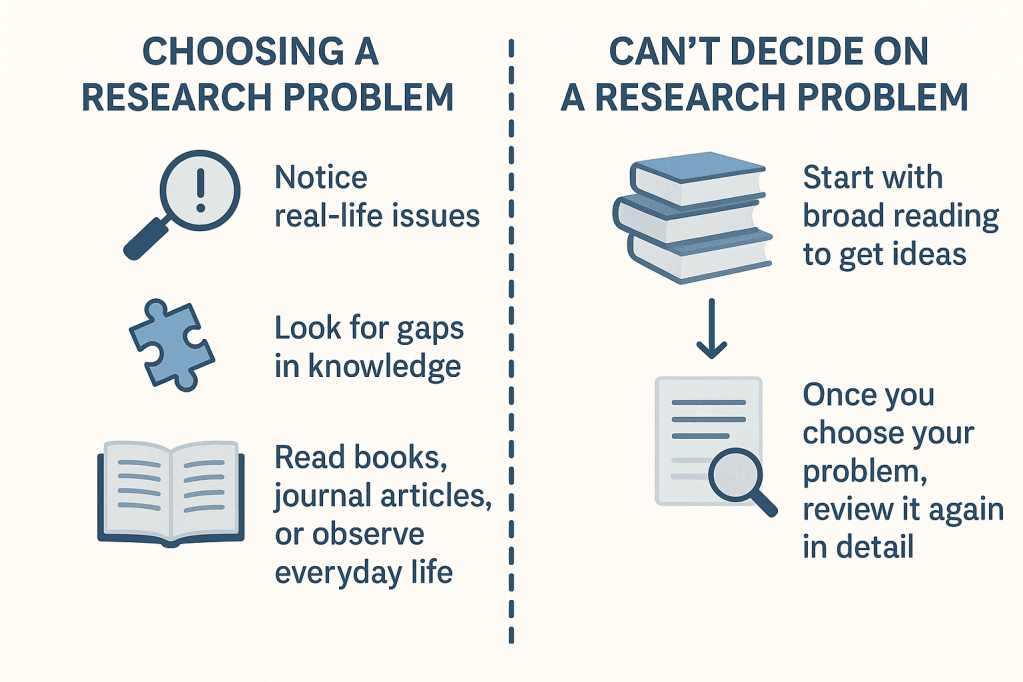
“2 ways to choose a research problem: 1st- you start with a specific research problem and focus only on materials related to it; or 2nd, if you’re unsure on what your problem should be then you explore widely across sources to discover a research problem.”
Ways to do reviewing right !
You can review literature in a few simple steps after you have picked your topic or research problem:
- Search for sources –
- Read and note key points
When you read a book, article, or thesis, don’t copy everything. Instead, note only the main things:
- What was studied? (e.g., stress in college students)
- How was it done? (survey, experiment, interview, etc.)
- What was found? (stress increases during exams, meditation helped, etc.
Keep short notes in a notebook, or use a table/excel to track these.
- Compare and connect
Once you have notes from different sources, place them side by side:
- Do two or more studies say the same thing? → agreement.
- Do they say opposite things? → disagreement.
- Did some study leave something unanswered? → gap.
This is where you start thinking—rather than only writing down what each study says, you link them together to see where they match, differ, or miss something.

- Summarize
Now, in your own words, tell the story of what you found:
- “Many studies show stress is higher in exams. Some say exercise helps, others say meditation works. But few have looked at how sleep patterns affect stress.”
“Reviewing literature made simple: Find sources, note key points, compare studies, and summarise gaps to shape your research problem.”
I’m hoping this explanation has helped clarify several points.
After this we face the super renowned Mr. hypotheses :)
Mr. Hypothesis who are you and what do you want?
Mr. hypothesis is guessed answers and it wants to find sure answers – lets see how
Question – “Does nutrition influence stress and academic performance in students?” – (research problem)
Answer – Now the answer can be one of the two things
- Yes, nutrition influences stress and academic performance in students.
- No, nutrition does not influence stress and academic performance in students.
These statements ( No.1 & 2 ) are hypotheses because they are temporary, guessed, untested prediction that will be tested through research to see which one holds true.

Types of Hypothesis
1. Null Hypothesis (H₀)
- Says there is always says no effect, no difference, no relationship.
- Example: No, nutrition does not influence stress and academic performance in students.
2. Alternative Hypothesis (H₁)
- Says there is an effect or relationship.
- Example: Yes, nutrition influences stress and academic performance in students.
Now when it says it has an “effect” then what kind of effect – positive, negative or nothing, what kind – lets see what kids of alternative hypotheses there be –
- Directional H₁ – says effect increases or decreases. (↑ or ↓)
- Non-directional H₁ – says effect exists, no clue which way
- Simple H₁ – only two variables. IV & DV
- Complex H₁ – more than two variables. Many IV & DV
- Associative H₁ – variables change together, no cause-effect.
- Causal H₁ – one variable causes the change in another, so cause-effect.


“H₀ assumes no effect, while H₁ predicts an effect: Directional, Non-directional, Simple, Complex, Associative, or Causal.”
What are signs of a good hypothesis?
- Clear and precise – Easy to understand, no confusing words.
- Specific – Focused on particular variables (not too broad).
- Testable – You can check it with data or experiments.
- Based on evidence/theory – Not random, but built from past research or logic.
- Predictive – Suggests what might happen (effect, relation, direction).
- Simple – Not overloaded with too many variables at once.
- Consistent – Fits with existing knowledge, doesn’t contradict well-proven facts.
- Falsifiable – There must be a way to prove it wrong if it’s not true.
A good hypothesis is clear, specific, testable, simple, and backed by logic or prior knowledge.
That is all you need to know about Reviewing literature & Formulating hypothesis.

CUET-type Questions
Q1. Reviewing literature in research mainly helps a researcher to:
a) Write long stories in reports
b) Avoid repeating already done work
c) Finalize research funding
d) Prove their hypothesis correct
Q2. Which of the following is the correct sequence while conducting research?
a) Hypothesis → Problem selection → Review of literature
b) Review of literature → Problem selection → Hypothesis formulation
c) Problem selection → Review of literature → Hypothesis formulation
d) Problem selection → Hypothesis formulation → Review of literature
Q3. While reviewing literature, if a researcher finds areas where existing studies disagree, this indicates:
a) A research gap
b) A hypothesis rejection
c) A null hypothesis
d) A poor review
Q4. A student picks the research problem “stress and academic performance in students.”
After reviewing literature, she narrows it to “how poor sleep adds to stress and lowers performance.”
This process is called:
a) Generalization
b) Hypothesis testing
c) Narrowing through literature review
d) Data analysis
Q5. Which of the following is a Null Hypothesis (H₀)?
a) Nutrition positively influences student performance.
b) Sleep deprivation leads to stress.
c) No relationship exists between nutrition and performance.
d) Stress and performance are associated.
Q6. Which is a Directional Hypothesis?
a) Nutrition influences stress.
b) Poor sleep reduces performance.
c) Stress and sleep are related.
d) Stress affects learning.
Q7. Assertion (A): A good hypothesis must be testable.
Reason (R): If it cannot be tested, it cannot be proved true or false.
a) Both A and R are true, and R is the correct explanation of A.
b) Both A and R are true, but R is not the correct explanation of A.
c) A is true, R is false.
d) A is false, R is true.
Q8. Assertion (A): Complex hypothesis involves many independent and dependent variables.
Reason (R): It predicts cause-effect between only two variables.
a) Both A and R are true, and R explains A.
b) Both A and R are true, but R does not explain A.
c) A is true, R is false.
d) A is false, R is true.
Q9. Assertion (A): Literature review helps in spotting research gaps.
Reason (R): Gaps show areas that have not been studied fully and can become new research problems.
a) Both A and R are true, and R is the correct explanation of A.
b) Both A and R are true, but R is not the correct explanation of A.
c) A is true, R is false.
d) A is false, R is true.
Q10. Assertion (A): All hypotheses are permanent answers.
Reason (R): They are only tested guesses until proven.
a) Both A and R are true, and R explains A.
b) Both A and R are true, but R does not explain A.
c) A is true, R is false.
d) A is false, R is true.
Answers Mapping:
1 – b
2 – c
3 – b
4 – c
5 – a
6 – c
7 – c
8 – a
9 – b
10 – c





Leave a Reply