
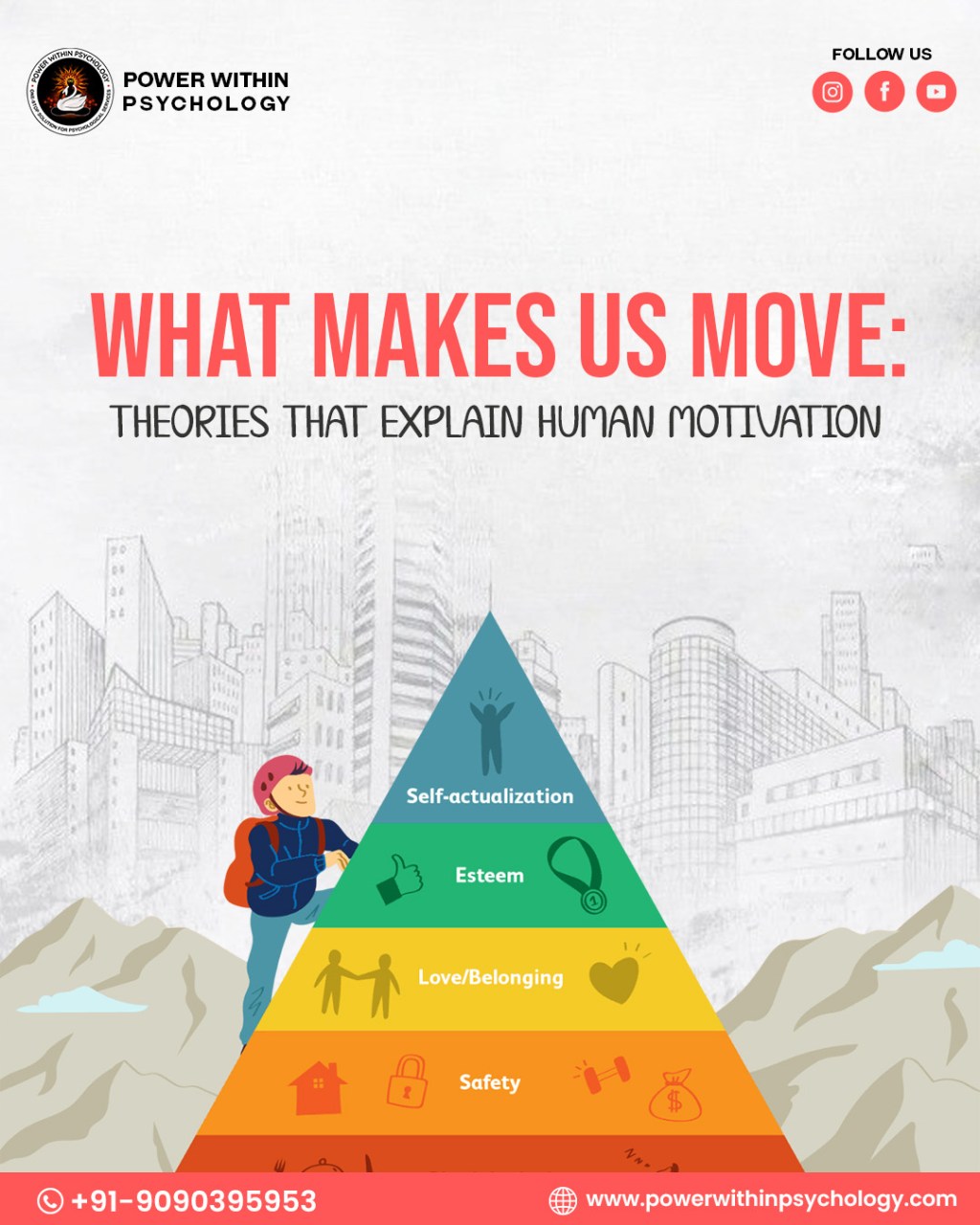
We think motivation is what makes us act but often it’s action that sparks motivation. Psychologists have long debated why we sometimes work for joy alone and other times only for rewards. From Pavlov’s dogs to Maslow’s pyramid, theories of motivation show that what drives us is never just one force so one mystery remains: are we ever truly driven from within, or is every motive shaped by something outside us?
Let’s look at how some of the great thinkers who paved the path of psychology tried to explain motivation – and what theorized about motivation

Early Theories of motivation v/s later theories
Instinct Theory (William James, 1890; McDougall, 1908) – motivation comes from survival instincts.(survival, protection, mating).
- Cycle: Threat to survival → Instinctive action (fight, flee, protect) → Safety achieved → Calm .
Drive Reduction Theory (Clark Hull, 1943)– motivation comes from wanting to get rid of biological needs (hunger, thirst, mating) in order to restore Homeostasis.
- Cycle: Need arises (hunger/thirst) → Drive increases → Action to reduce drive (eat, drink) → Need satisfied → Homeostasis restored.
Arousal Theory (Yerkes & Dodson, 1908)– motivation comes when imbalance of psychological state is struct and we wish to attain an optimal level of arousal. Too much arousal can break you & too little can sell you short, so we seek for optimal arousal to perform effectively and efficiently)
- Cycle: Too little/too much arousal → Motivation to adjust arousal → Optimal balance reached → Calm/Focus.
Incentive Theory (early 1900s; Edward Thorndike & later Skinner in 1930s–40s)– motivation comes from wanting to gain a reward or avoid punishment.
- Cycle: External cue (reward/punishment expected) → Motivation to act → Action performed → Reward gained / Punishment avoided → Behavior reinforced.
Maslow’s Hierarchy of Needs (Abraham Maslow, 1943)– motivation comes from wanting to become better in life and achieve more from deficit needs to growth needs on Maslow’s pyramid.
- Cycle: Lower need unmet (e.g., hunger) → Motivated to fulfill it → Need satisfied → Move upward to higher need (safety → love → esteem → self-actualization) → Continuous growth.
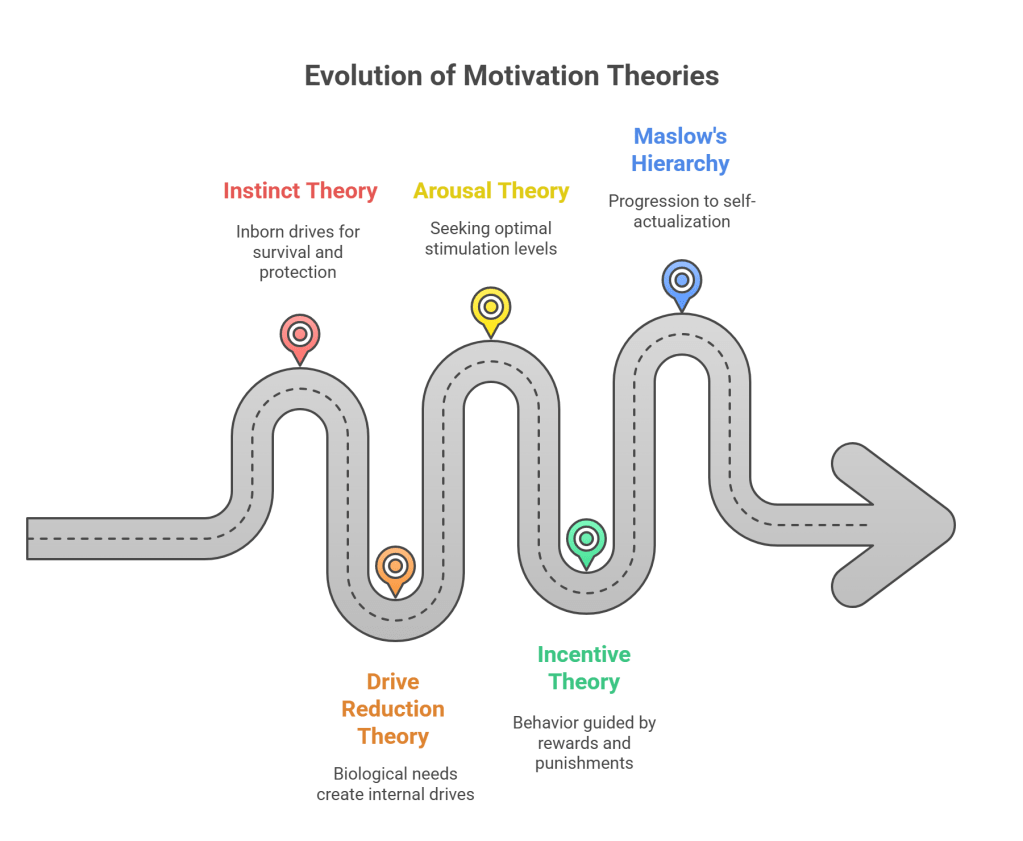
Now that we know the first 5 theories, we can look at the later theories that introduced more complex and detailed views on content and process.

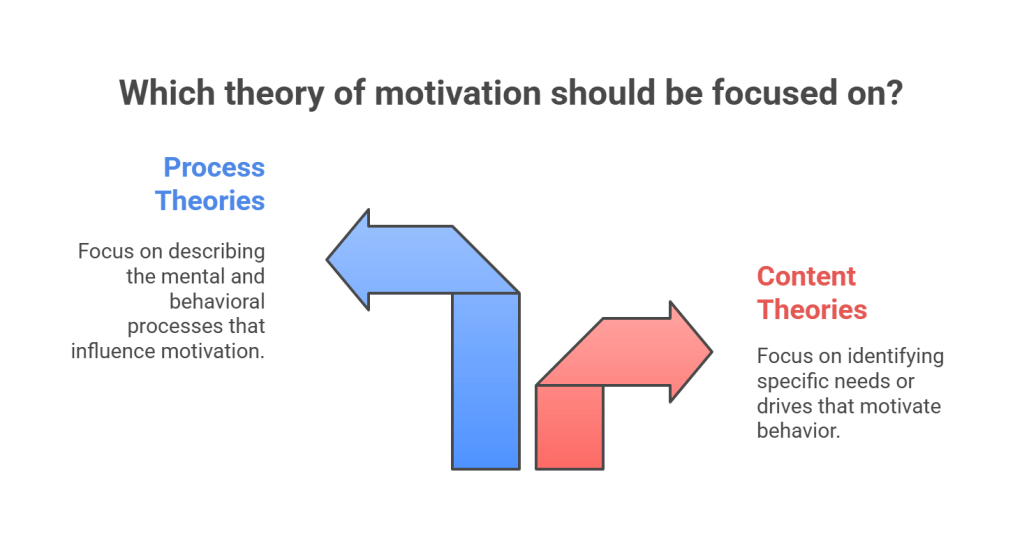
Content Theories of Motivation → These explain what specifically motivates people by identifying individual needs or drives that push behavior.( hunger, reward/punishment, overwhlemed psychological state, growth). You got it right all the early theior talked about what motivated us.
Need → Action → Satisfaction → Calm.
Process Theories of Motivation → These explain how motivation works by describing the mental and behavioral processes that influence effort, choice, and persistence.
Goal Expected → Effort Made → Result Achieved → Reward Evaluated → Decide Next Action
Now let’s look at the theories under these two types.
Theories of Motivation: Content vs. Process
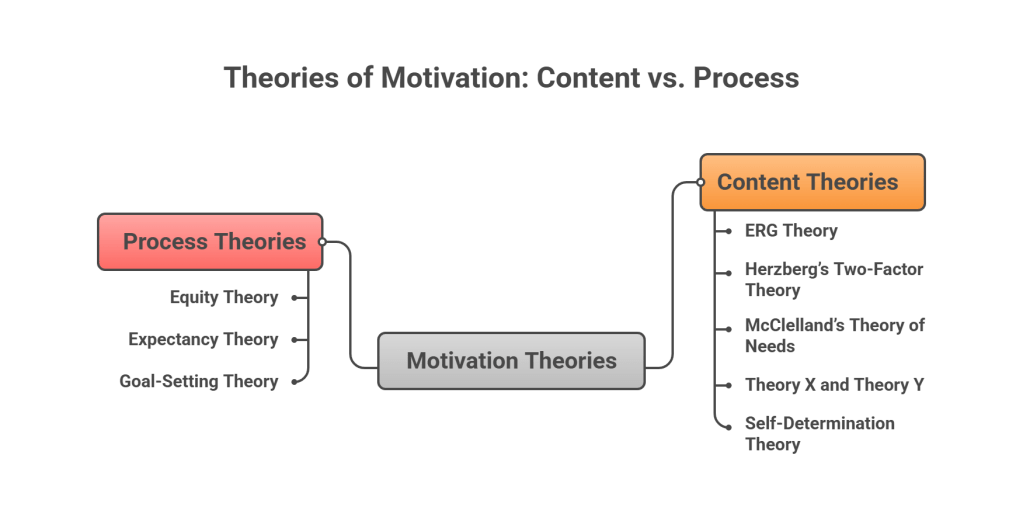
Content Theories (Focus on Needs – What motivates?)
- Herzberg’s Two-Factor Theory (1959)
- Motivation at work depends on two sets of factors:
- Hygiene factors (salary, work conditions, policies) prevent dissatisfaction.
- Motivators (achievement, recognition, growth) create satisfaction.
- Idea: Removing dissatisfaction is not enough — motivators must be present.
- Motivation at work depends on two sets of factors:
- McClelland’s Theory of Needs (1961)
- People are driven by three learned needs:
- Achievement (nAch): desire to excel.
- Power (nPow): need to influence others.
- Affiliation (nAff): need to belong and maintain relationships.
- Different individuals are motivated by different dominant needs.
- People are driven by three learned needs:
- Theory X and Theory Y – McGregor (1960)
- Theory X: Managers assume employees dislike work, avoid responsibility → need strict control.
- Theory Y: Managers assume employees enjoy work, seek responsibility → thrive under empowerment.
- Motivation depends on how management views human nature.
- ERG Theory – Alderfer (1969)
- Simplified Maslow’s hierarchy into 3 needs:
- Existence (E): basic survival (like Maslow’s physiological + safety).
- Relatedness (R): social and interpersonal needs.
- Growth (G): personal development.
- Unlike Maslow, ERG allows needs to overlap and regress.
- Simplified Maslow’s hierarchy into 3 needs:
- Self-Determination Theory – Deci & Ryan (1985)
- True motivation is intrinsic (comes from within).
- Humans have 3 psychological needs:
- Autonomy: control over own actions.
- Competence: feeling effective.
- Relatedness: connection with others.
- External rewards can sometimes reduce intrinsic motivation
Process Theories (Focus on Process – How motivation works?)
- Equity Theory – Adams (1963)
- People compare their input–output ratio (effort vs. reward) with others.
- If they perceive unfairness (inequity), they adjust effort or attitude.
- Motivation comes from the sense of fairness.
- Expectancy Theory – Vroom (1964)
- Motivation depends on three factors:
- Expectancy: belief that effort → performance.
- Instrumentality: belief that performance → reward.
- Valence: value placed on the reward.
- Formula: Motivation = Expectancy × Instrumentality × Valence.
- Motivation depends on three factors:
- Goal-Setting Theory – Locke (1968)
- Clear, specific, challenging goals increase motivation.
- Feedback is essential to track progress.
- “Do your best” goals are less motivating than measurable ones.

MCQs on Motivation Theories
Q1. Instinct Theory of motivation, as proposed by William James and McDougall, suggests that behavior is primarily driven by:
a) Rewards and punishments
b) Learned social values
c) Survival instincts such as protection and mating
d) Goal-setting and feedback
Q2. According to Clark Hull’s Drive Reduction Theory, the main force behind motivation is:
a) The pursuit of rewards
b) The reduction of biological needs to restore balance
c) The comparison of inputs and outputs
d) The need for personal growth
Q3. The Yerkes-Dodson Law (Arousal Theory) suggests:
a) Motivation decreases as arousal increases
b) Too much or too little arousal harms performance, while moderate arousal helps
c) Only rewards can sustain performance
d) Arousal has no effect on motivation
Q4. Incentive Theory emphasizes that motivation is driven by:
a) Internal instincts
b) The desire to gain rewards or avoid punishments
c) Physiological drives only
d) Hierarchical growth needs
Q5. Maslow’s Hierarchy of Needs explains motivation as:
a) Cyclical tension between arousal and calm
b) Satisfaction of lower-level needs before progressing to higher ones
c) Pursuit of fairness and balance
d) Direct connection between effort and performance
Q6. Which of the following is a Content Theory?
a) Equity Theory
b) Expectancy Theory
c) Goal-Setting Theory
d) Herzberg’s Two-Factor Theory
Q7. McClelland’s Theory of Needs includes which three learned needs?
a) Autonomy, Competence, Relatedness
b) Achievement, Power, Affiliation
c) Survival, Protection, Growth
d) Equity, Expectancy, Valence
Q8. According to Adams’ Equity Theory, motivation depends on:
a) Comparison between personal effort–reward ratio and others’ ratio
b) Clear and specific goals
c) Optimal psychological arousal
d) Reduction of biological drives
Q9. Which theory proposed that specific, challenging goals with feedback improve performance?
a) Goal-Setting Theory – Locke
b) Drive Reduction Theory – Hull
c) Theory X and Theory Y – McGregor
d) ERG Theory – Alderfer
Q10. Self-Determination Theory (Deci & Ryan, 1985) argues that true motivation arises from:
a) External punishments
b) Intrinsic needs for autonomy, competence, and relatedness
c) Hierarchical safety and growth
d) Balance of arousal levels

Answers
- c
- b
- b
- b
- b
- d
- b
- a
- a
- b





Leave a Reply