


Table of Content


Introduction
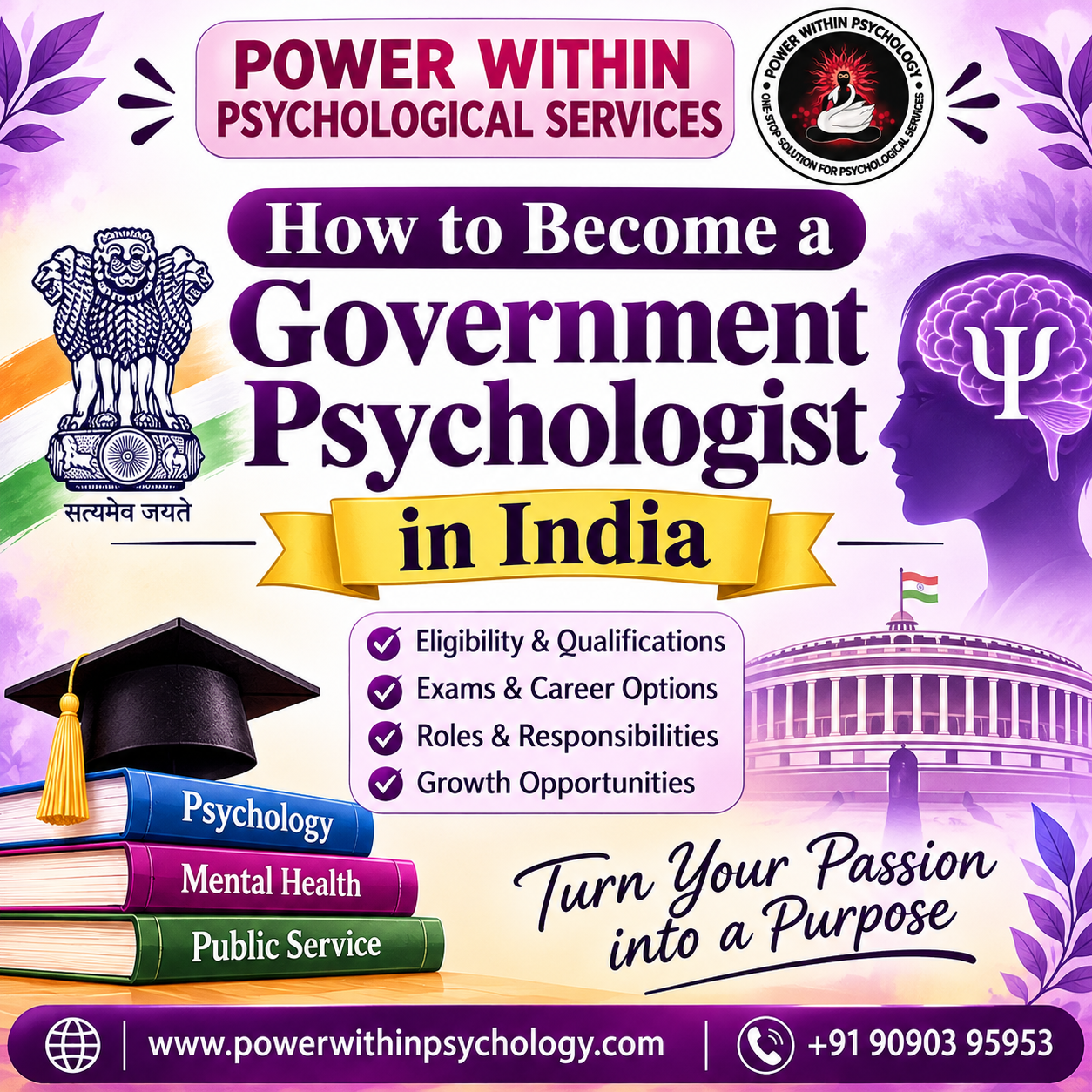
A career as a government psychologist offers opportunities to work in healthcare, education, child protection, rehabilitation and public mental health services. With increasing awareness of psychological well-being in India, government institutions require trained professionals who can contribute to psychological assessment, counselling, research and mental health support.
For psychology graduates and postgraduate students, the government sector offers several career pathways. However, the qualifications and professional requirements differ according to the designation.
This article explains how to become a government psychologist in India, the educational qualifications required, major recruiting departments and available career opportunities.
Who Is a Government Psychologist?
A government psychologist is a qualified professional working in a government department, public institution or government-funded organisation. Their responsibilities depend on their area of specialisation and the position they hold.
Some common responsibilities include:
- Conducting psychological assessments and behavioural evaluations.
- Providing counselling and psychological support.
- Supporting children and adolescents experiencing emotional or behavioural difficulties.
- Assisting individuals with mental health and rehabilitation needs.
- Participating in mental health awareness programmes.
- Maintaining psychological records and preparing assessment reports.
- Contributing to research and community mental health initiatives.
Government psychologists may work in clinical, educational, counselling, rehabilitation or research settings.
Educational Qualifications Required
The educational requirements depend on the specific government position. However, pursuing undergraduate and postgraduate education in psychology is a common pathway.
Step 1: Complete a Bachelor’s Degree in Psychology
Candidates can pursue undergraduate programmes such as:
- BA Psychology
- BA (Hons.) Psychology
- BSc Psychology
During graduation, students develop foundational knowledge of general psychology, developmental psychology, social psychology, personality, cognitive processes and research methods.
Step 2: Pursue a Master’s Degree in Psychology
After graduation, candidates can pursue:
- MA Psychology
- MSc Psychology
- MA Applied Psychology
- MSc Applied Psychology
- Other relevant postgraduate specialisations.
A postgraduate qualification is required for many professional and specialist psychology positions.
Step 3: Obtain Specialised Professional Qualifications
Certain positions, particularly those of Clinical Psychologist, require additional professional qualifications and registration as prescribed by the Rehabilitation Council of India (RCI).
Candidates should explore RCI-recognised clinical psychology programmes and verify the current course requirements before admission. The professional qualification and registration requirements must be fulfilled for positions where RCI recognition is mandatory.
Importantly, a general MA or MSc in Psychology does not automatically qualify someone to practise or apply for every Clinical Psychologist position.


Government Departments and Organisations That Recruit Psychologists
Psychology professionals can explore opportunities in several government sectors.
A. Government Hospitals and Medical Institutions
Government hospitals and mental health institutions recruit psychologists and clinical psychologists for assessment, intervention and patient support.
Some important institutions include:
- All India Institute of Medical Sciences (AIIMS).
- National Institute of Mental Health and Neurosciences (NIMHANS).
- Postgraduate Institute of Medical Education and Research (PGIMER).
- Government medical colleges.
- State government hospitals and mental health institutions.
Depending on the designation, professionals may work in clinical assessment, psychological interventions, research and multidisciplinary mental healthcare.
B. Women and Child Development Department
The Women and Child Development Department provides opportunities in child protection, counselling and rehabilitation-related services.
Psychologists may contribute to:
- Psychological support for children.
- Child protection and welfare programmes.
- Emotional and behavioural assessment.
- Counselling and rehabilitation services.
- Supporting children in institutional care.
For example, the Government of NCT of Delhi has notified recruitment rules for the post of Clinical Psychologist in its Department of Women and Child Development.
C. National Health Mission (NHM)
The National Health Mission provides opportunities for psychology professionals through various state-level health programmes.
Some relevant areas include:
- District Mental Health Programmes.
- District Early Intervention Centres.
- Child development and rehabilitation services.
- Community mental health initiatives.
Vacancies and eligibility requirements vary according to the state and specific programme.
D. Government Schools and Educational Institutions
Psychologists and counsellors can also explore opportunities in government educational institutions.
Their responsibilities may include student counselling, career guidance, emotional support, behavioural interventions, educational assessment and mental health awareness activities.
E. Correctional Institutions and Prison Departments
Psychologists may work in prisons, juvenile justice institutions and correctional facilities. Their responsibilities can include behavioural assessment, psychological support, rehabilitation planning and interventions aimed at improving emotional and social functioning.


Is RCI Registration Required for Government Psychologist Jobs?
The Rehabilitation Council of India (RCI) is a statutory body responsible for regulating and maintaining standards of training and professional registration in specified rehabilitation-related fields.
Clinical Psychologists are included among the professional categories registered under the Central Rehabilitation Register (CRR).
For positions involving the regulated professional role of Clinical Psychologist, candidates must fulfil the applicable recognised qualification and registration requirements.
However, RCI registration is not a universal requirement for every psychology-related government position. General psychologist, counsellor and research positions may have different eligibility conditions depending on their recruitment rules.
Candidates should refer to the official RCI website to verify recognised qualifications, approved institutions and current registration requirements.
Skills Required to Become a Psychologist
Apart from academic qualifications, psychology professionals should develop the following competencies:
- Communication Skills: Ability to communicate effectively with individuals, families and multidisciplinary teams.
- Empathy and Active Listening: Understanding individual concerns without judgement.
- Psychological Assessment: Knowledge of appropriate assessment methods and their interpretation.
- Research Skills: Understanding research methodology, statistics and data analysis.
- Ethical Practice: Maintaining confidentiality, informed consent and professional boundaries.
- Documentation: Preparing psychological reports, case histories and professional records.
- Problem-Solving: Applying psychological knowledge to different individual and community needs.
How to Prepare for Government Psychologist Recruitment?
Candidates should follow a focused preparation strategy according to their desired job profile.
1. Strengthen Core Psychology Subjects: Study General Psychology, Developmental Psychology, Social Psychology, Cognitive Psychology, Abnormal Psychology, Personality Psychology and Biological Psychology.
2. Study Psychological Assessment: Understand psychological testing, assessment procedures, research methods and statistical concepts.
3. Develop Applied Knowledge: Revise counselling approaches, mental health concepts, behavioural assessment and professional ethics according to the requirements of the desired position.
4. Gain Relevant Practical Experience: Participate in appropriate supervised training, internships and research activities wherever relevant to the professional role.
5. Follow Official Recruitment Updates: Regularly visit the recruitment sections of government hospitals, medical institutions, NHM, state health departments and Women and Child Development departments.
Conclusion
A career as a government psychologist in India offers opportunities to contribute to mental health services, education, rehabilitation, child welfare and public healthcare. Candidates must choose their educational qualifications according to the specific role they wish to pursue, as the eligibility criteria vary across government departments and institutions. Those aspiring to become Clinical Psychologists should pay particular attention to RCI-recognised qualifications and registration requirements.
With the right academic preparation, practical experience and understanding of recruitment requirements, psychology graduates can explore meaningful career opportunities in the government sector and contribute to the mental well-being of individuals and communities.