


Table of Content
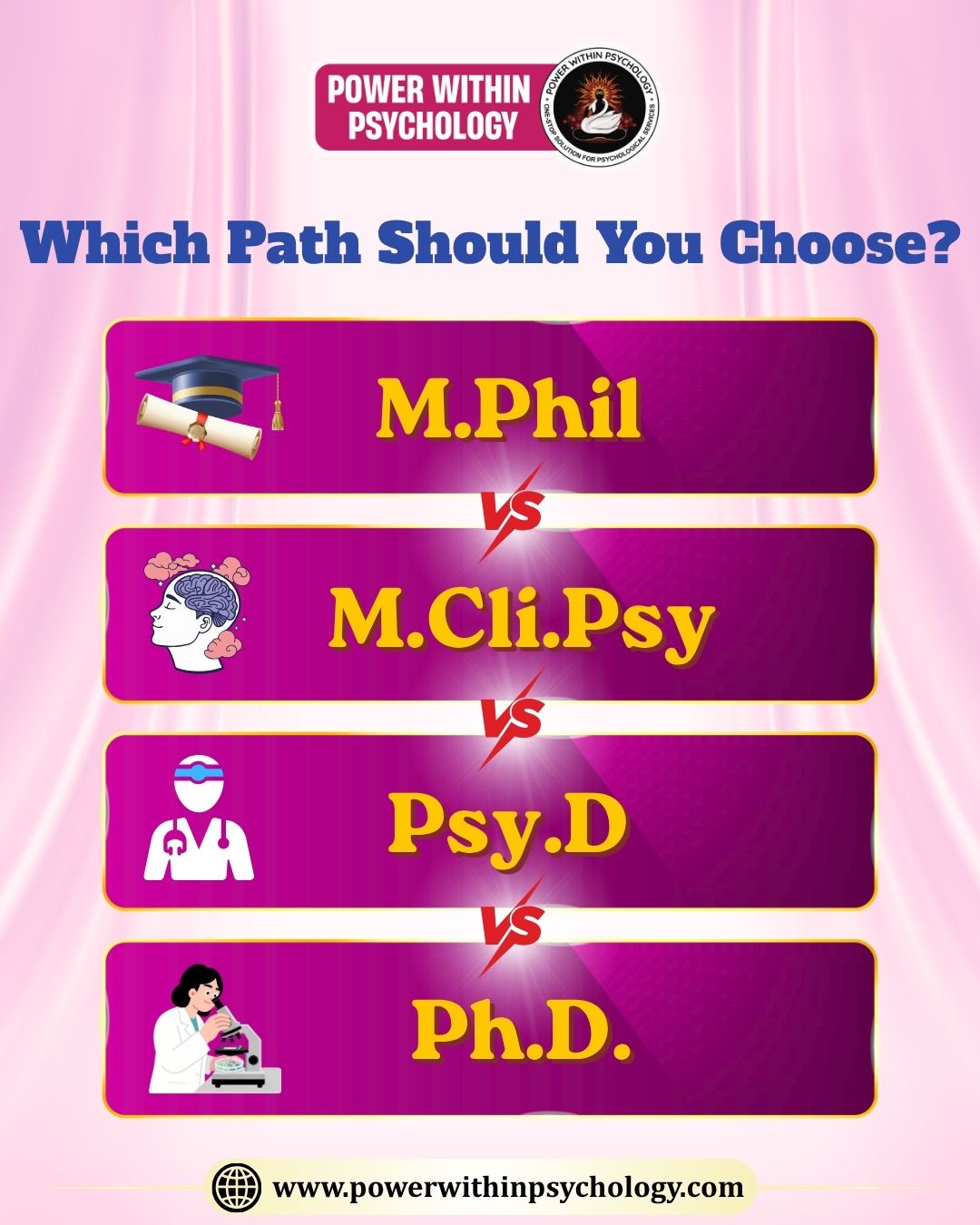
Clinical Psychology is one of the most sought-after career paths for Psychology graduates in India. However, students often get confused between M.Phil in Clinical Psychology, Master in Clinical Psychology (M.Clin.Psy), Psy.D and Ph.D.
So, what exactly is the difference between these degrees? And more importantly, which one is meant for clinical practice, research, teaching or becoming a doctor in psychology?


M.Phil, M.Clin.Psy, Psy.D and Ph.D
| Programme | Nature | Duration | Main Focus | Professional Relevance |
|---|---|---|---|---|
| M.Phil Clinical Psychology | Professional | 2 years | Clinical practice, assessment, therapy and research | Traditional RCI route; continuation was permitted for 2024–25 and 2025–26 |
| M.Clin.Psy | Professional | 2 years | Clinical assessment, intervention, therapy and research | New RCI-regulated professional master’s programme |
| Psy.D Clinical Psychology | Professional Doctorate | 4 years | Advanced clinical practice and supervised training | RCI-regulated professional doctoral programme |
| Ph.D in Psychology/Clinical Psychology | Research Doctorate | Varies | Research and academic expertise | Ph.D alone should not be confused with an RCI professional clinical qualification |


M.Phil in Clinical Psychology
- Duration: 2 years.
- Eligibility: Master’s degree in Psychology with the minimum marks and other requirements prescribed by RCI and the respective institution.
M.Phil in Clinical Psychology was one of the principal professional training routes for becoming an RCI-registered Clinical Psychologist in India.
Unlike a conventional academic master’s degree, M.Phil Clinical Psychology was strongly practice-oriented. Students received supervised training in areas such as:
- Psychological assessment
- Clinical interviewing
- Psychopathology
- Psychological testing
- Psychotherapy
- Behaviour therapy
- Cognitive-behavioural approaches
- Child and adolescent assessment
- Adult clinical work
- Rehabilitation
- Case formulation
- Clinical documentation
- Research and dissertation
- Professional ethics
The programme involved extensive supervised clinical exposure and practical training.
Why was M.Phil important?
M.Phil Clinical Psychology was not simply a theoretical course. Its purpose was to develop professional competencies required for clinical work.
Therefore, an M.Phil from an RCI-recognized institution, along with the required professional registration, became an important pathway for clinical psychology practice in India.
Is M.Phil still available?
Students need to be particularly careful here.
The broader higher-education framework moved towards discontinuation of M.Phil programmes. However, RCI issued a notice permitting M.Phil Clinical Psychology to continue for the academic sessions 2024–25 and 2025–26.
Therefore, students should not assume that every institution advertising M.Phil Clinical Psychology has valid current RCI approval.
Before applying, always verify:
- Whether the institution is currently RCI-approved.
- Whether the specific programme is approved for the relevant academic session.
- Whether the programme appears in RCI’s official programme information.
- Whether the qualification is eligible for the applicable professional registration.
Master in Clinical Psychology -M.Clin.Psy
- Duration: 2 years.
- Eligibility:4-year Bachelor’s degree in Psychology (or equivalent)
Master in Clinical Psychology (M.Clin.Psy.) is the newer professional master’s-level programme introduced under the RCI framework as the clinical psychology training structure transitions away from M.Phil.
The programme was initially introduced as M.A. Clinical Psychology and its nomenclature was changed to Master in Clinical Psychology (M.Clin.Psy.) by RCI in May 2026.
Major areas include:
- Psychological assessment and testing
- Psychopathology and case conceptualisation
- Psychotherapy and psychological interventions
- Child and adult mental health
- Rehabilitation and community mental health
- Research methodology and professional ethics
Is M.Clin.Psy. the Same as M.A. Psychology?
No. A regular M.A./M.Sc. Psychology is generally an academic postgraduate degree, whereas M.Clin.Psy. is structured as a professional clinical psychology programme under the RCI framework.
Therefore, students should always check the recognition and professional status of the specific programme rather than assuming that every course titled “Clinical Psychology” has the same professional value.
Psy.D in Clinical Psychology
- Duration: 4 years.
- Eligibility: Master’s degree in Psychology with the minimum marks and other requirements prescribed by RCI and the respective institution.
Psy.D stands for Doctor of Psychology. It is a professional doctorate designed primarily for advanced clinical training rather than purely academic research.
RCI’s regular-mode programme information lists Psy.D in Clinical Psychology as a 4-year programme.
What is the Main Focus?
- Psy.D places strong emphasis on advanced clinical practice, psychological assessment, psychotherapy, clinical decision-making and supervised clinical experience.
- Research is also part of the programme, but the primary orientation is professional practice.
- The training therefore follows a practitioner–scholar approach, combining clinical expertise with knowledge of psychological research.
Psy.D vs Ph.D
The simplest distinction is:
Psy.D → primarily professional and clinical practice-oriented
Ph.D → primarily research and academic-oriented
Both are doctoral-level programmes, but their training objectives are different.
Ph.D in Psychology / Clinical Psychology
- Duration: Usually 3–6 years, depending on the university and applicable regulations.
- Eligibility: Master’s degree in Psychology or a relevant/allied subject with the minimum marks prescribed by the university and applicable UGC regulations.
A Ph.D is a research doctorate that prepares students for advanced research and academic work in a specialised area of Psychology.
The programme generally involves coursework, literature review, research methodology, data collection and analysis, thesis writing and viva voce. The exact structure varies between universities.
Ph.D programmes may be available in areas such as Clinical Psychology, Counselling Psychology, Cognitive Psychology, Developmental Psychology, Social Psychology, Health Psychology, Educational Psychology and Organisational Psychology.
Does a Ph.D Make You an RCI Clinical Psychologist?
- No. A Ph.D in Psychology or Clinical Psychology does not automatically make a person an RCI-registered Clinical Psychologist.
- This is an important distinction because a Ph.D is primarily a research qualification, while professional clinical practice is governed by the applicable RCI-recognized qualification and registration requirements.
Therefore, students who specifically want to become Clinical Psychologists should verify the RCI recognition and registration pathway of the programme rather than relying only on the word “Clinical” in its title.
Here are the step-by-step instructions to check RCI (Rehabilitation Council of India) approved institutions on the official RCI website:
- Visit the Official RCI Website Go to rehabcouncil.nic.in.
- Navigate to Approved Institutions
- On the top menu bar, hover over Programmes / Activities.
- Click on Institution or Approved Institutions from the dropdown options.
- Select the Mode of Study
- Choose Regular Mode (or Distance Mode, depending on the course format you are interested in).
- Access the Approved List
- Click on the link titled List of RCI’s approved training institutes and their current status of academic year with intake per batch.
- Download the PDF document provided on the page to view the full state-wise list of recognized institutes, approved courses, and batch intake capacities.


At Power Within Psychology, we provide guidance and learning support across a wide range of Psychology pathways-from RCI-related Clinical Psychology programmes to preparation for major Psychology examinations and other academic and professional opportunities.
If you are unsure about which course or career path is right for you, connect with Power Within Psychology for personalised guidance and the right direction for your Psychology journey.
Contact via WhatsApp at +91 8013666663, email at powerwithinpsychology@gmail.com, or visit our website for more information. CLICK HERE






Share this article by Power Within Psychology (PWP):

Discover more from Power Within Psychology | BLOGS
Subscribe to get the latest posts sent to your email.