

Welcome to The Psychology Lab Chronicles, where we explore experiments that changed how we understand the mind. We’ll journey through Perception & Sensation, Memory & Cognition, Emotion & Motivation, Social Psychology, Developmental Psychology, and Biological Psychology — uncovering the fascinating studies that shaped what we know today.
These experiments are among the most frequently discussed in psychology entrance and qualification exams like CUET (Central University Entrance Test) and UGC NET (National Eligibility Test) because they form the core foundation of psychological science and theory application. These exams focus on testing conceptual clarity, experimental understanding, and real-world relevance of psychological constructs such as obedience, conformity, learning, memory, emotion, perception, and social behaviour.

Before we jump into these famous experiments, let’s clear up two small but powerful ideas: Learning & Conditioning.
Learning: When an experience changes your behaviour.
Example — You see dark clouds and decide to carry an umbrella next time.
Conditioning: When your brain connects one thing with another.
Example — You hear the school bell and feel hungry, even if it’s not lunch break.
Here’s the twist: you can’t learn without first noticing something… but sometimes what you notice can fool you.
- Learning example: Your friend doesn’t wave, so you “learn” they’re angry — but really, they didn’t see you.
- Conditioning example: You hear the ice cream cart bell and feel happy — but today, the cart’s empty.
Take Pavlov’s dogs — they heard a bell (perception) and decided “food’s coming!” (learning).
Or Bandura’s kids — they saw adults whacking a Bobo doll (perception) and thought, “Okay, that’s how we treat toys” (learning).
So, next time you notice something — like someone smiling — are you sure you know why they’re smiling, or are you just making a guess?

Must-Know Learning & Conditioning Experiments
- Pavlov – Classical Conditioning (Dogs)
- Skinner – Operant Conditioning (Skinner Box)
- Watson & Rayner – Little Albert
- Bandura – Bobo Doll Experiment
- Tolman – Cognitive Maps (Rats in Maze)
- Köhler – Insight Learning (Chimpanzees)
- Seligman – Learned Helplessness (Dogs)
Experiments
A video has been added to the heading of all experiments to allow understanding of concepts visually.
1. Pavlov – Classical Conditioning (Dogs)
Pavlov rang a bell and then gave food to the dogs. After some time, the dogs started salivating just by hearing the bell. They learned to connect bell = food. This shows how we can link two things in our mind even if they were unrelated before.
Concepts discovered during the experiment:
- Unconditioned Stimulus (UCS) – Something that naturally causes a response (food → salivation).
- Unconditioned Response (UCR) – The natural reaction to the UCS (salivation to food).
- Conditioned Stimulus (CS) – A neutral thing that, after learning, triggers the response (bell).
- Conditioned Response (CR) – The learned reaction to the CS (salivation to the bell).
- Spontaneous recovery – After a break, the reaction came back a little when the bell rang again.
- Acquisition – The starting phase, when the dog began linking the bell with food.
- Generalisation – Reacting to similar sounds, not just the original bell.
- Extinction – When the bell rang, but no food came, the reaction slowly faded.
- Contiguity principle – Learning works best when the neutral stimulus and the unconditioned stimulus are close in time.
- Temporal Contiguity – arranged from most to least effective
- Trace Conditioning → Signal first, then food after a short gap.
- Delay Conditioning → Signal continues until food appears.
- Simultaneous Conditioning → Signal and food start together.
- Backward Conditioning → Food first, then signal (usually least effective).
- Association strength – The pairing works faster if the CS is distinctive or strong.
- Higher-order conditioning – A new neutral stimulus (like a light) can also trigger the response if it’s paired with the CS (bell).
2. Bandura – Bobo Doll Experiment
Children watched adults behaving aggressively towards a large inflatable doll named Bobo. Later, when given the chance, many children copied the same aggressive actions. They did not need direct teaching or rewards — they learned simply by watching. This showed that behaviour can be learned through observation, not just direct experience.
Concept
- Vicarious/Observational Learning– We’re more likely to copy or learn a behaviour if we see the model being rewarded, less likely if they’re punished.
- Attention, Retention, Reproduction, Motivation – Four key steps in observational / Vicarious learning: notice the behaviour, remember it, be able to do it, and want to do it.

- Modelling – Copying the behaviour of a person (the “model”) you observe.
- Reciprocal Determinism – Behaviour, environment, and personal factors (thoughts, feelings) all influence each other.

3. Skinner – Operant Conditioning (Skinner Box)
Skinner put rats in a box with a lever. If they pressed the lever, they got food. Jab reward mila, rats ne baar-baar press karna shuru kiya. This showed that behaviour increases with reward.
Concept:
- Operant Conditioning – Learning where behaviour is controlled by consequences
- ( Reinforcement & Punishment )
- Reinforcement → Used to increase a behaviour.
- Punishment → Used to decrease a behaviour.
- Positive = Addition of a stimulus.
- Negative = Removal of a stimulus.
- Positive Reinforcement → Add something pleasant to increase behaviour (e.g., praise, food).
- Negative Reinforcement → Remove something unpleasant to increase behaviour (e.g., turn off loud noise).
- Positive Punishment → Add something unpleasant to decrease behaviour (e.g., scolding).
- Negative Punishment → Remove something pleasant to decrease behaviour (e.g., no TV).

- Consequential Behaviour – Actions are more or less likely depending on the outcomes they produce
- Shaping – Rewarding small steps toward the desired behaviour.
- Schedules of Reinforcement – Rules for when rewards are given (fixed ratio, variable ratio, etc.), which change how quickly and strongly behaviours form.

4. Watson & Rayner – Little Albert
They showed a white rat to Baby Albert and paired it with a loud, scary noise (hammer hitting a steel bar). After several pairings, Albert cried and showed fear at the rat alone — even without the noise.
What was learned? Fear is not always inborn — it can be classically conditioned (learned through association).
Concept–
- Classical Conditioning → Learning by associating a neutral stimulus (rat) with an unconditioned stimulus (loud noise) that naturally triggers fear.
- Neutral Stimulus (NS) → White rat (initially no fear).
- Unconditioned Stimulus (US) → Loud noise (naturally scary).
- Unconditioned Response (UR) → Fear/crying from loud noise.
- Conditioned Stimulus (CS) → White rat after pairing with loud noise.
- Conditioned Response (CR) → Fear of seeing the white rat.

- Emotional Conditioning → Applying classical conditioning to emotions (fear here).
- Stimulus Generalisation → Albert also feared similar objects like a rabbit, dog, fur coat, and even a Santa Claus beard – pretty much anything that reminded the poor kid of the rat.
5. Tolman – Cognitive Maps (Rats in Maze)
Rats were allowed to wander a maze without any food reward. Later, when food was placed at the end, these rats quickly found the shortest route — faster than rats who had never explored.
What was learned? Learning can occur without immediate rewards; organisms can form mental representations of their environment.
Concepts –
- Active Exploration → Even without reinforcement, experience builds knowledge.
- Latent Learning → Learning happens but isn’t shown until there’s a reason to use it (e.g., food reward).
- Cognitive Map → Internal mental layout of the maze helps rats navigate efficiently.
- Role of Motivation → The reward revealed the learning that had already occurred.
- Challenge to Behaviourism → Contradicted the strict Skinnerian view that learning requires reinforcement.

6. Köhler – Insight Learning (Chimpanzees)
Chimpanzees saw bananas placed out of reach. Instead of trial-and-error, they suddenly combined objects (like joining sticks or stacking boxes) to reach the food. The solution appeared all at once — a “lightbulb moment.”
What was learned? Animals can solve problems by mentally reorganising the situation, not just by random attempts.
Concept:
- Insight Learning → Sudden understanding of a solution after mentally grasping the whole problem.
- Perception of the Whole → Seeing how all parts of the problem fit together.
- Restructuring → Mentally reinterpreting the situation to find a solution.
- Application of Past Experience → Using knowledge from previous situations to solve a new one.
- Gestalt Psychology Link → Emphasised that problem-solving is holistic, not mechanical.

7. Seligman – Learned Helplessness (Dogs)
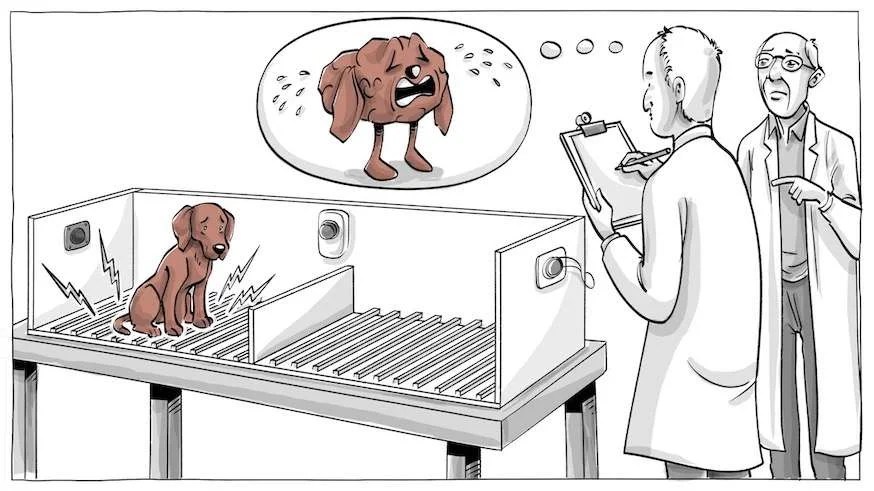
Dogs were placed in a situation where they received unavoidable electric shocks. Later, when they were moved to a setup where escape was possible (by jumping over a low barrier), many did not even try. They had learned that “nothing I do will help”.
What was learned? Repeated experiences of no control can create a mindset of helplessness, leading to passivity even when opportunities to escape or improve appear.
Concept:
- Learned Helplessness → A psychological state where an individual stops trying due to repeated failures or uncontrollable events.
- Loss of Motivation → They don’t act because they expect failure.
- Emotional Symptoms → Depression, apathy, anxiety.
- Cognitive Symptoms → Belief that efforts are useless, reduced problem-solving.
- Behavioural Passivity → No attempts to change the situation

Let’s test your learning with CUET-style MCQs
1. In Pavlov’s classical conditioning experiment, the bell before being paired with food is called:
a) Unconditioned Stimulus
b) Conditioned Stimulus
c) Neutral Stimulus
d) Conditioned Response
2. Which sequence is the most effective for classical conditioning according to the principle of temporal contiguity?
a) Backward Conditioning
b) Simultaneous Conditioning
c) Trace Conditioning
d) Random Conditioning
3. Bandura’s Bobo Doll experiment demonstrated that:
a) Learning only happens through rewards and punishments
b) Observational learning can occur without direct reinforcement
c) Children always imitate adults
d) Motivation is not important in learning
4. Which of the following is an example of negative reinforcement?
a) Giving a child candy for cleaning their room
b) Turning off a loud alarm after pressing a button
c) Taking away a child’s phone for being late
d) Yelling at someone for being late
5. In Skinner’s operant conditioning, removing a pleasant stimulus to reduce behaviour is called:
a) Positive Punishment
b) Negative Punishment
c) Positive Reinforcement
d) Negative Reinforcement
6. Watson and Rayner’s Little Albert study demonstrated:
a) Observational learning
b) Latent learning
c) Emotional conditioning through classical conditioning
d) Insight learning
7. Tolman’s cognitive map study with rats challenged behaviourism because it showed:
a) Learning requires reinforcement
b) Learning can occur without immediate rewards
c) Reinforcement is the only way to shape behaviour
d) Stimulus generalization happens with similar objects
8. Köhler’s chimpanzee experiments supported which psychological perspective?
a) Behaviourism
b) Gestalt Psychology
c) Psychoanalysis
d) Cognitive Dissonance Theory
9. The “lightbulb moment” in problem-solving is most closely linked to:
a) Trial-and-error learning
b) Insight learning
c) Classical conditioning
d) Learned helplessness
10. Seligman’s learned helplessness experiment is best described as:
a) Motivation increasing after success
b) Passivity due to repeated uncontrollable events
c) Shaping behaviour through small steps
d) Problem-solving without reinforcement
Answers
- c
- c
- b
- b
- b
- c
- b
- b
- b
- b
Share this article by Power Within Psychology (PWP):

Discover more from Power Within Psychology | BLOGS
Subscribe to get the latest posts sent to your email.