




Have you ever wondered why some people crave solitude while others can’t go a day without company? Or why some make decisions from the heart while others rely on cold logic?
These differences fascinated Carl Gustav Jung, the Swiss psychiatrist who laid the foundation for modern personality typology in his 1923 classic “Psychological Types.”
Let’s unpack his ideas and see how they eventually gave rise to one of the world’s most popular personality models: the Myers–Briggs Type Indicator (MBTI).
If you haven’t taken it yet, grab a friend (or just your curiosity) and try it. Warning: it’s way more fun than it sounds!
The Core Idea: How the Mind Orients Itself
Jung believed our minds have natural preferences for ways we direct energy, process information, make decisions, and interact with the world.
He proposed that personality differences arise from two main aspects:
Attitudes – The direction of psychic energy
- Introversion: Energy flows inward. Such people are reflective, reserved, and drawn to their inner thoughts.
- Extraversion: Energy flows outward. These individuals feel alive in social settings and are oriented toward people and activity.
Jung emphasised that no one is purely introverted or extraverted, it’s a matter of degree. But one side usually dominates.
Functions – The way we process information and make sense of reality
- Jung described four primary psychological functions, divided into two pairs:
| Function Type | Description |
|---|---|
| Thinking | Logical, analytical, seeks objective truth (“What is true?”) |
| Feeling | Values-based, emotional, seeks harmony (“What feels right?”) |
| Sensing | Relies on direct experience, the five senses (“What is here and now?”) |
| Intuition | Looks beyond facts, focuses on patterns and possibilities (“What could be?”) |
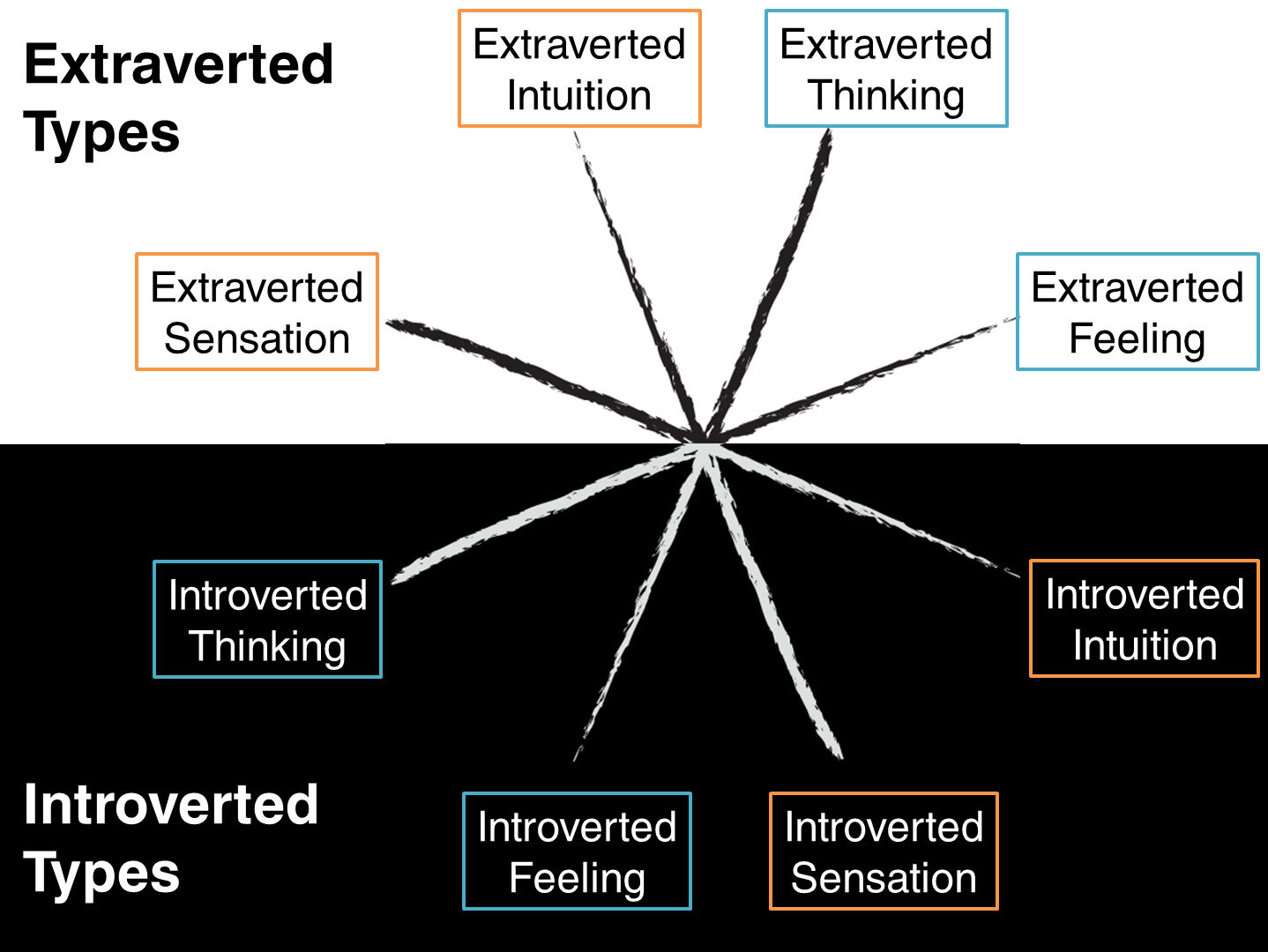
The Eight Psychological Types
By combining the two attitudes (Introversion & Extraversion) with the four functions, Jung created eight personality types:
| Attitude | Dominant Function |
|---|---|
| Extraverted Thinking | Logical, decisive, objective, focused on facts and systems |
| Introverted Thinking | Analytical, internal logic, seeks deep understanding |
| Extraverted Feeling | Warm, expressive, socially attuned |
| Introverted Feeling | Quietly loyal to inner values, empathetic |
| Extraverted Sensing | Lives fully in the moment, enjoys sensory experiences |
| Introverted Sensing | Reflective, nostalgic, attentive to past details |
| Extraverted Intuition | Sees patterns, possibilities, and future opportunities |
| Introverted Intuition | Visionary, symbolic, focused on inner insights |
Each person has one dominant function and others that play supporting roles. For example, an introverted intuitive may rely on deep insights and visions, while an extraverted sensor thrives in hands-on, real-world engagement.

From Jung to Myers & Briggs
After Jung, his work caught the attention of an American mother–daughter duo, Katharine Cook Briggs and Isabel Briggs Myers, who wanted to make Jung’s ideas practical for everyday life.
During World War II, they developed a personality test to help people find suitable careers and improve workplace understanding. This became the Myers–Briggs Type Indicator (MBTI), one of the most widely used personality assessments today.
The MBTI: Expanding Jung’s Framework
The MBTI builds directly on Jung’s model but adds two more dimensions, making personality typing more specific.
| MBTI Dimension | Description |
|---|---|
| 1. Extraversion (E) – Introversion (I) | Energy direction (outward vs inward) |
| 2. Sensing (S) – Intuition (N) | Information processing (facts vs patterns) |
| 3. Thinking (T) – Feeling (F) | Decision-making (logic vs values) |
| 4. Judging (J) – Perceiving (P) | Lifestyle preference (structured vs flexible) |
The Judging–Perceiving dimension was added by Myers & Briggs, not Jung.
It reflects how people prefer to organise their external world, whether they like order and closure (J) or spontaneity and openness (P).
The 16 MBTI Types: A Snapshot
Each personality type is a 4-letter combination (e.g., INFJ, ESTP) representing a unique mix of preferences.
| Category | Types | Description |
|---|---|---|
| Analysts (Rational, Strategic) | INTJ, INTP, ENTJ, ENTP | Independent thinkers, problem solvers, idea-driven |
| Diplomats (Empathetic, Visionary) | INFJ, INFP, ENFJ, ENFP | Guided by ideals, value harmony and meaning |
| Sentinels (Organized, Reliable) | ISTJ, ISFJ, ESTJ, ESFJ | Responsible, practical, tradition-oriented |
| Explorers (Adventurous, Adaptable) | ISTP, ISFP, ESTP, ESFP | Spontaneous, action-oriented, fun-loving |
Key Differences Between Jung’s Theory and MBTI
| Aspect | Jung’s Psychological Types | MBTI |
|---|---|---|
| Created by | Carl Jung (1923) | Katharine Briggs & Isabel Myers (1940s) |
| Core Dimensions | 2 Attitudes + 4 Functions | 4 Dichotomies (adds Judging–Perceiving) |
| Total Types | 8 | 16 |
| Purpose | Explain psychological preferences | Help self-understanding & career guidance |
| Assessment Tool | None (theory only) | MBTI Questionnaire |
Why MBTI Became So Popular
- Simple & relatable – Four letters that describe complex personality patterns.
- Non-judgmental – No “good” or “bad” types. Every type has strengths.
- Practical use – Common in workplaces, education, counselling, and team building.
- Self-awareness tool – Helps people understand how they communicate, decide, and grow.
Criticisms & Cautions
Psychologists often point out that MBTI:
- Low reliability – results may change over time.
- Low validity – weak at predicting real behaviour or performance.
- Forced dichotomies – ignore that traits exist on a spectrum.
- No lie detection scale – responses can be easily faked.
- Cultural bias – not equally valid across cultures.
- Not for selection or diagnosis – lacks scientific accuracy for such use.
- Over-labelling risk – people may limit themselves to fixed “types.”
- Simplistic – reduces complex personalities to just 16 types.
- Better for self-awareness, not for judging or comparing others.
Still, many find it helpful as a framework for reflection, not as a rigid label.

Final Thoughts
Jung’s original vision wasn’t to box people into types but to help them understand their natural tendencies, the rhythm of their mind.
When Myers and Briggs expanded on his ideas, they offered the world a way to explore self-awareness and human diversity in an accessible form.
So whether you identify as an INFJ dreamer or an ESTP doer, remember Jung’s message:
“The privilege of a lifetime is to become who you truly are.
Share this article by Power Within Psychology (PWP):

Discover more from Power Within Psychology | BLOGS
Subscribe to get the latest posts sent to your email.