







Ever wondered why some people crave adventure while others love quiet routines? Why are some friends so chill while others panic over a missed deadline?
Introduction: What Is Trait Theory?
Trait Theory is one of the most influential approaches to understanding personality.
It assumes that our behaviour is shaped by consistent, measurable characteristics called traits that remain relatively stable across time and situations.
Unlike type theories, which classify people into rigid categories (like introvert or extrovert), trait theory views personality as a continuum that everyone possesses each trait in varying degrees.
Over time, researchers refined this approach to create models that capture these traits more precisely.
Among them, two stand out as the most comprehensive and empirically supported frameworks:
- The Big Five (OCEAN) by Robert McCrae and Paul Costa
- The HEXACO Model by Kibeom Lee and Michael Ashton
Both are connected through their shared goal to identify the fundamental dimensions of human personality, yet HEXACO expands upon OCEAN by adding a moral dimension.
These two models together form the foundation of modern personality assessment and cross-cultural research.
Psychologists Robert McCrae and Paul Costa believe the answer lies in five simple but powerful personality traits, the Big Five, often remembered by the acronym OCEAN.

The Origin Story – The Big Five (OCEAN)
In the 1980s, McCrae and Costa built upon years of research to create the Five-Factor Model (FFM), one of the most accepted frameworks in modern psychology.
Instead of classifying people into types, they described personality as a spectrum of measurable traits, continuous dimensions that every person possesses in varying degrees.
So, no one is 100% introverted or extroverted; we all fall somewhere in between.
That’s what makes the Big Five so realistic and widely used in research, counselling, and even HR!

The Five Dimensions (OCEAN)
1. Openness to Experience
- Curious, imaginative, creative minds score high here.
- Low scorers prefer structure, familiarity, and routine.
Think of that friend who always wants to try a new café versus the one who says, “Let’s just go to the usual place.”
2. Conscientiousness
- Organised, dependable, disciplined people top this trait.
- Low scorers may be spontaneous or even careless.
This is your planner-carrying buddy versus the one who forgets every deadline.
3. Extraversion
- Outgoing, talkative, energetic individuals rank high.
- Introverts aren’t “shy” they just draw energy from solitude.
Picture someone loving a party crowd vs. another recharging with a book.
4. Agreeableness
Warm, empathetic, and cooperative individuals are high in this.
- Low scorers can be more competitive or skeptical.
Think of your most helpful friend vs. the brutally honest one.
5. Neuroticism
- Measures emotional stability.
- High scorers experience anxiety, mood swings, and self-doubt.
- Low scorers stay calm and resilient.
We all have that one friend who panics easily and another who stays Zen.

The Birth of HEXACO
Psychologists Kibeom Lee and Michael Ashton revisited personality data from multiple cultures and languages.
They discovered a sixth dimension that kept appearing across studies related to sincerity, fairness, and modesty.
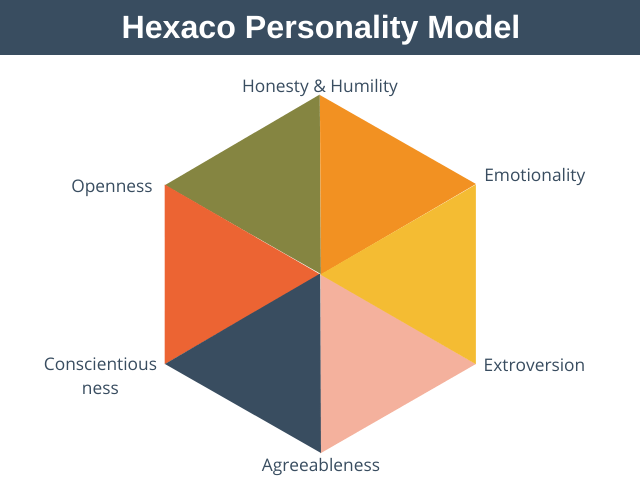
That new dimension became H – Honesty–Humility, forming the HEXACO model:
| Letter | Trait Name | Core Qualities |
|---|---|---|
| H | Honesty – Humility | Sincerity, fairness, modesty, lack of greed |
| E | Emotionality | Sensitivity, sentimentality (similar to Neuroticism) |
| X | Extraversion | Sociability, enthusiasm, energy |
| A | Agreeableness | Forgiveness, patience, tolerance |
| C | Conscientiousness | Organization, diligence, self-discipline |
| O | Openness to Experience | Imagination, curiosity, creativity |
Why HEXACO Matters
- Adds a moral dimension to personality research.
- Improves the prediction of behaviours like cheating, bullying, altruism, and leadership ethics.
- Used in organisational psychology, forensic studies, and cross-cultural research.
- Emphasises that personality isn’t just about who we are, but also how we treat others.
Big Five vs HEXACO
| Feature | Big Five (OCEAN) | HEXACO |
|---|---|---|
| Traits | 5 | 6 |
| Extra Dimension | – | Honesty–Humility |
| Emotionality | Neuroticism | Emotionality (includes sentimentality) |
| Focus | Behavior description | Moral & ethical aspects |
| Developers | Costa & McCrae | Ashton & Lee |
| Use | Academic, counseling, HR | Research, ethics, global studies |
Practice Quiz (10 MCQs)
Q1. Who developed the HEXACO model?
a) Costa & McCrae
b) Jung & Adler
c) Ashton & Lee
d) Cattell
Q2. How many dimensions does the HEXACO model include?
a) 4
b) 5
c) 6
d) 7
Q3. The “H” in HEXACO stands for:
a) Humor
b) Honesty–Humility
c) Humanity
d) Hopefulness
Q4. Which Big Five trait is most similar to Emotionality in HEXACO?
a) Openness
b) Conscientiousness
c) Neuroticism
d) Agreeableness
Q5. Which trait differentiates HEXACO from the Big Five?
a) Openness
b) Honesty–Humility
c) Conscientiousness
d) Extraversion
Q6. HEXACO emphasizes which additional aspect of personality?
a) Creativity
b) Morality and ethics
c) Social adaptability
d) Ambition
Q7. The Big Five model was proposed by:
a) Freud & Jung
b) Costa & McCrae
c) Bandura & Skinner
d) Sheldon & Eysenck
Q8. The HEXACO model was developed in which year range?
a) 1920s
b) 1950s
c) 1980s
d) 2000s
Q9. Which of the following is NOT a HEXACO trait?
a) Agreeableness
b) Conscientiousness
c) Integrity
d) Openness
Q10. HEXACO’s Emotionality includes which quality?
a) Sentimentality
b) Arrogance
c) Dishonesty
d) Impulsivity
Answers
- c
- c
- b
- c
- b
- b
- b
- d
- c
- a










Leave a Reply