




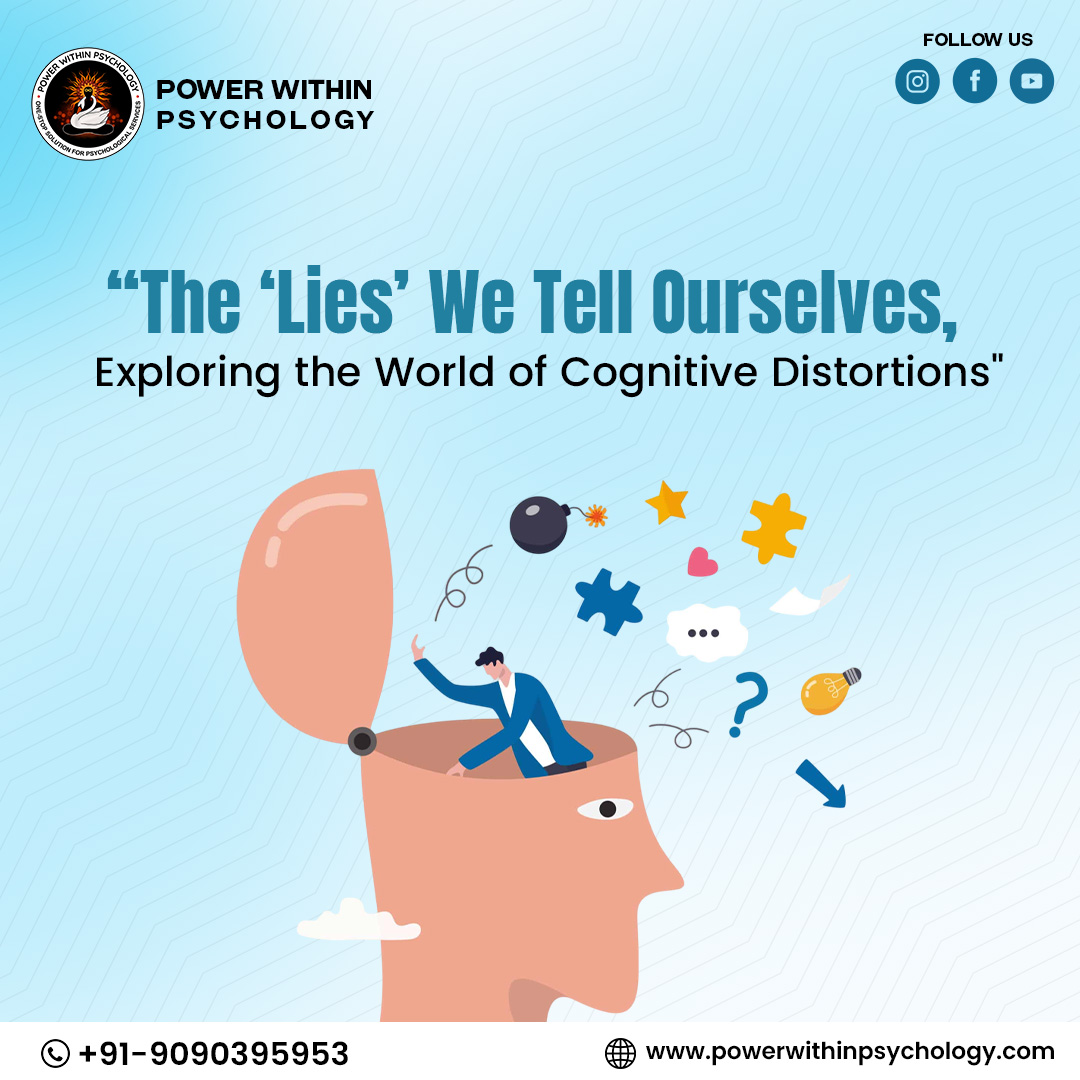
Ever spiraled over a small mistake, thinking, “I always mess up. Maybe I’m not good enough,” even if it was just one bad day? That’s the effect of cognitive distortions which are deeply ingrained, automatic thought patterns that twist our reality. They’re not just negative thoughts but recurring beliefs that shape how we see ourselves, others and the world. Over time, they start to feel real. At the core of Cognitive Behavioral Therapy (CBT) lies a powerful idea – by identifying and changing these distortions, we can change how we think, feel and behave.
What we think (“They’re ignoring me. I must’ve done something wrong”) affects how we feel (Anxious, rejected, maybe even angry), which affects what we do (You avoid them, overthink, maybe send a cold message)
So, when our thinking is distorted, our emotional world follows and we don’t just feel bad we live as if those distorted thoughts are the truth.
The story of Cognitive Distortions started in the 1960s, when psychiatrist Aaron T. Beck was working with patients who had depression. He noticed something unusual. It wasn’t just their mood that was low but their thoughts seemed rigged against them. People weren’t just saying they felt hopeless but they were also thinking in hopeless patterns. Beck realized these patients weren’t lying or exaggerating. But their thoughts were filtered through a lens of bias and error. This led to the inception of the concept of cognitive distortions which are a set of predictable, habitual thinking errors.
How CBT and Cognitive Distortions Entered Everyday Conversation –
- Aaron T. Beck developed Cognitive Behavioral Therapy (CBT)—now one of the most widely used therapies—to help individuals recognize, examine, and challenge cognitive distortions.
- David D. Burns brought Beck’s clinical insights to the public through his bestselling book Feeling Good: The New Mood Therapy (1980).
- Burns popularized the concept of cognitive distortions by giving them clear names, relatable examples, and practical tools.
- His work made cognitive distortions a common topic not just in therapy rooms but also in psychology classrooms and self-help spaces.
The Thought Triangle – How One Shift Changes Everything –
Imagine your mind as a bustling newsroom. Thoughts zip around like breaking news. Some are loud headlines, others whispers in the background. But not all of them are fact-checked. That’s where CBT (Cognitive Behavioral Therapy) steps in, like the editor-in-chief of your mind.
Let’s say one morning before a big exam, you accidentally spill coffee on your notes. Instantly, a thought pops up: “I’m such a mess. I always screw things up.” This is what CBT calls a Negative Automatic Thought (NAT) whic is a quick, unfiltered reaction we barely notice. But it comes from somewhere.
Behind that one thought might be a deep core belief, something you’ve carried for years without realizing, like “I’m not capable” or “If I fail, I’m worthless.” Sitting in the middle are intermediate beliefs which are the invisible rules you live by, like “If I make a mistake, people won’t respect me.”
In therapy, the goal isn’t to erase these thoughts with sunshine and rainbows. It’s to gently trace them—like a reporter chasing the real story. You and your therapist begin to –
- Notice the NATs – catching the unspoken “headlines” that run through their mind.
- Trace them down to deeper beliefs – by asking, “Where did this thought come from?”
- Challenge the distortions – asking, “Is this true? Is there another way to see this?”
- Rewrite the script – replacing that fast, irrational voice with a grounded, balanced one.
So instead of “I failed once, I’ll always fail,” it becomes: “Yes, I failed. But that doesn’t mean I can’t improve.”
In CBT, thoughts, feelings, and behaviors are all connected like corners of a triangle. One shift changes the whole structure. And when you start fact-checking your mind’s headlines, you begin to live a story that’s kinder, calmer and more real.

CBT Seeks To Alleviate Psychological Stresses By Correcting Faulty Conceptions And Self-Signals. By Correcting Erroneous Beliefs We Can Lower Excessive Reactions. – Aaron Beck
Some Cognitive Distortions That Hijack Our Thinking are as follows –
| Cognitive Distortion | Description | Example |
| 1. All-or-Nothing Thinking / Black-and-White Thinking | You live in extremes; it’s either perfect or a disaster. | You score 85% on a test. Instead of feeling good, your brain says, “If it’s not 90%, it’s a failure. I’m useless.” |
| 2. Overgeneralization | One bad event equals a lifetime of bad events. You hit “repeat” on every failure. | You were once rejected in a relationship. “That’s it. No one will ever love me.” |
| 3. Mental Filter | You focus only on the negative and ignore the positive. | You get praised for a presentation, but one person says “It was okay.” That’s all you remember. |
| 4. Disqualifying the Positive | You reject or downplay good things. Compliments bounce off. | Professor says, “Great job.” You think, “She’s just being nice. She probably says that to everyone.” |
| 5. Jumping to Conclusions | You make negative assumptions without evidence. | Mind Reading: “He didn’t wave back. He must hate me.”Fortune Telling: “I just know this exam is going to be a disaster.” |
| 6. Catastrophizing / Magnification | You imagine the worst-case scenario every time. | You fumble a sentence in a meeting. “That’s it. Everyone thinks I’m incompetent. My career’s over.” |
| 7. Minimization | You succeed, but convince yourself it wasn’t a big deal. | “Sure, I won the award. But honestly, anyone could’ve done it.” |
| 8. Emotional Reasoning | You believe your feelings are facts. | “I feel anxious. Something bad is definitely going to happen.” |
| 9. ‘Should’ Statements | You pressure yourself or others with impossible “shoulds” and “musts.” | “I should never cry in front of people.” or “He should know what I’m feeling without me saying it.” |
| 10. Labeling and Mislabeling | You define yourself with harsh labels instead of describing the event. | You stumble during a discussion and think, “I’m so stupid. I’m just not cut out for this field.” |
| 11. Personalization | You believe you are the cause of everything bad. | “My friend is upset. I must’ve said something wrong.” |
| 12. Control Fallacy | You believe you either have no control or complete control over everything. | External: “There’s nothing I can do. Life just happens to me.”Internal: “Everything is up to me. If something goes wrong, it’s my fault.” |
| 13. Fairness Fallacy | You expect life to always be fair based on your effort. | “I worked harder than her. Why did she get the promotion?” |
| 14. Heaven’s Reward Fallacy | You believe good behavior should guarantee immediate rewards. | “I’ve always been kind and honest. So why is everything still going wrong?” |

The Step-by-Step Process of Cognitive Change –
Cognitive distortions don’t just pop into our minds once in a while, they often operate silently like an autopilot mode. That’s why the first and most essential step in therapy is learning to catch them. In CBT, clients are trained to develop an inner radar for automatic thoughts. They’re often so fast, we don’t even realize we’re thinking them. But they do influence how we feel and what we do, within seconds. Like, a person may receive neutral feedback and instantly think, “They’re disappointed in me” even if nothing was actually said. In therapy, this moment becomes gold. Clients are encouraged to slow down their inner monologue, recognize the thought as it arises and begin examining it more closely.
Once that awareness is built, CBT moves into one of its most powerful tools which is socratic questioning or guided discovery. This is where the therapist becomes a detective who is searching for thoughts. Therapists ask questions like, “What’s the evidence for this thought?” “Is there another way to view the situation?” “Would you say this to a friend in the same position?” These questions aren’t meant to argue with the client’s emotions but to help them take a step back and look at their thoughts more objectively, often for the first time.
Next step is of Thought Records or in simple terms a Thought Diary. These are structured worksheets where clients log their experiences like what happened, what they thought, how they felt, what distortion was present and finally, how to reframe that thought in a more balanced way.
Example –
Situation | Automatic Thought | Emotion | Distortion | Balanced Thought |
| Didn’t get a response to a job application | “I’m not good enough. I’ll never get hired.” | Hopeless, anxious | Overgeneralization, catastrophizing | “This is one rejection. It doesn’t mean I won’t succeed elsewhere.” |
These exercises help clients externalize and examine their internal experiences, transforming abstract mental chaos into something concrete, compassionate and manageable. Over time, this process becomes second nature through a technique called cognitive restructuring. The aim is not to force toxic positivity but to gradually replace habitual, distorted thinking with truthful, rational and self-supportive alternatives. It’s like installing a mental filter that’s less biased, less harsh and more balanced.

Cognitive Distortions in Mental Health Conditions –
| Disorder | Common Cognitive Distortions | Examples / Description |
| Depression | – Mental Filtering – All-or-Nothing Thinking – Catastrophizing | Focuses only on what went wrong, ignores positives. Views life in extremes (e.g., total failure or success). Exaggerates setbacks as proof of worthlessness. |
| Anxiety Disorders | – Fortune Telling – Emotional Reasoning – Overgeneralization | Predicts worst-case scenarios (“Something bad will happen”). Believes something is true just because they feel it. Uses one event to form broad negative conclusions. |
| Obsessive-Compulsive Disorder (OCD) | – Personalization – “Should” Statements | Believes that having a thought means they caused or are responsible for it. Holds rigid rules like “I should never make mistakes,” increasing guilt and anxiety. |
| Eating Disorders | – Labeling – Minimization | Harsh self-judgment (“I’m disgusting”). Downplays harmful behaviors (“Skipping meals isn’t a big deal”) to justify or hide disordered eating and shame. |
These distortions may look different from person to person, but the core idea remains of how we think is how we live. Reframing your thoughts won’t happen overnight. But each time you catch a distortion, question it and replace it, one thought at a time.
You are not your thoughts. And when you learn to question them, you begin to reclaim your mind from the noise and make space for something kinder, truer and deeply healing.
MCQs for Practice –
1. Which of the following best illustrates the progression from automatic thoughts to core beliefs within the CBT framework?
A. “I feel sad” → “My sadness is irrational” → “I must always be happy”
B. “I failed once” → “I’m hopeless” → “I am worthless”
C. “I succeeded” → “I should feel proud” → “Success is always deserved”
D. “They ignored me” → “They’re rude” → “I am superior”
2. In CBT, Socratic Questioning is primarily used to:
A. Replace irrational thoughts with affirmations
B. Strengthen clients’ emotional expressions through catharsis
C. Challenge automatic thoughts by promoting evidence-based reflection
D. Suppress negative thinking by introducing mindfulness-based reframing
3. A client says, “I messed up one task. Now they’ll think I’m incompetent and I’ll lose my job.” Which set of cognitive distortions is most likely operating here?
A. Personalization, Labeling, Emotional Reasoning
B. Fortune Telling, Catastrophizing, Overgeneralization
C. Disqualifying the Positive, Control Fallacy, Mind Reading
D. All-or-Nothing Thinking, Minimization, Fairness Fallacy
4. Which of the following best differentiates ‘Mental Filtering’ from ‘Disqualifying the Positive’?
A. Mental filtering suppresses emotional responses, while disqualifying the positive exaggerates them.
B. Mental filtering allows for positivity but focuses on outcomes, while disqualifying the positive rejects emotional reasoning.
C. Mental filtering involves attending only to the negative aspects, while disqualifying the positive actively invalidates the good.
D. Mental filtering stems from childhood schemas, whereas disqualifying the positive is a result of adult trauma.
5. In the CBT thought record process, the main purpose of writing down distortions is to:
A. Help therapists predict future behaviors of clients
B. Reduce emotional pain by expressing frustration
C. Objectify internal experiences and support cognitive restructuring
D. Provide clients with a sense of control through routine journaling
6. Which distortion is most likely reinforced by the “Heaven’s Reward Fallacy” and may increase emotional burnout in high-achieving individuals?
A. Control Fallacy
B. Emotional Reasoning
C. All-or-Nothing Thinking
D. Should Statements
Answer Key –
1 – B – Solution: This follows the CBT cognitive model: a Negative Automatic Thought (I failed once) stems from an intermediate belief (I’m hopeless) rooted in a core belief (I am worthless).
2 – C – Solution: Socratic questioning helps clients critically analyze their thoughts by asking open-ended, reflective questions such as “What’s the evidence for this thought?” promoting cognitive restructuring, not suppression or emotional release.
3 – B – Solution: The client predicts a negative future (fortune telling), imagines the worst-case scenario (catastrophizing), and generalizes one mistake to a broader negative outcome (overgeneralization).
4 – C – Solution: Mental Filtering selectively focuses on the negative (eg – ignoring praise), whereas Disqualifying the Positive explicitly rejects or invalidates positive experiences (eg – “They’re just being nice”).
5 – C – Solution: The primary goal of thought records is to externalize internal cognitive patterns, helping clients analyze, reframe, and restructure their thoughts more objectively.
6 – D – Solution: The Heaven’s Reward Fallacy leads to disappointment when good behavior doesn’t yield rewards. This reinforces “Should” Statements (eg – “I should be rewarded for working hard”), causing internal pressure and eventual emotional fatigue.
Share this article by Power Within Psychology (PWP):

Discover more from Power Within Psychology | BLOGS
Subscribe to get the latest posts sent to your email.