

Table of Content
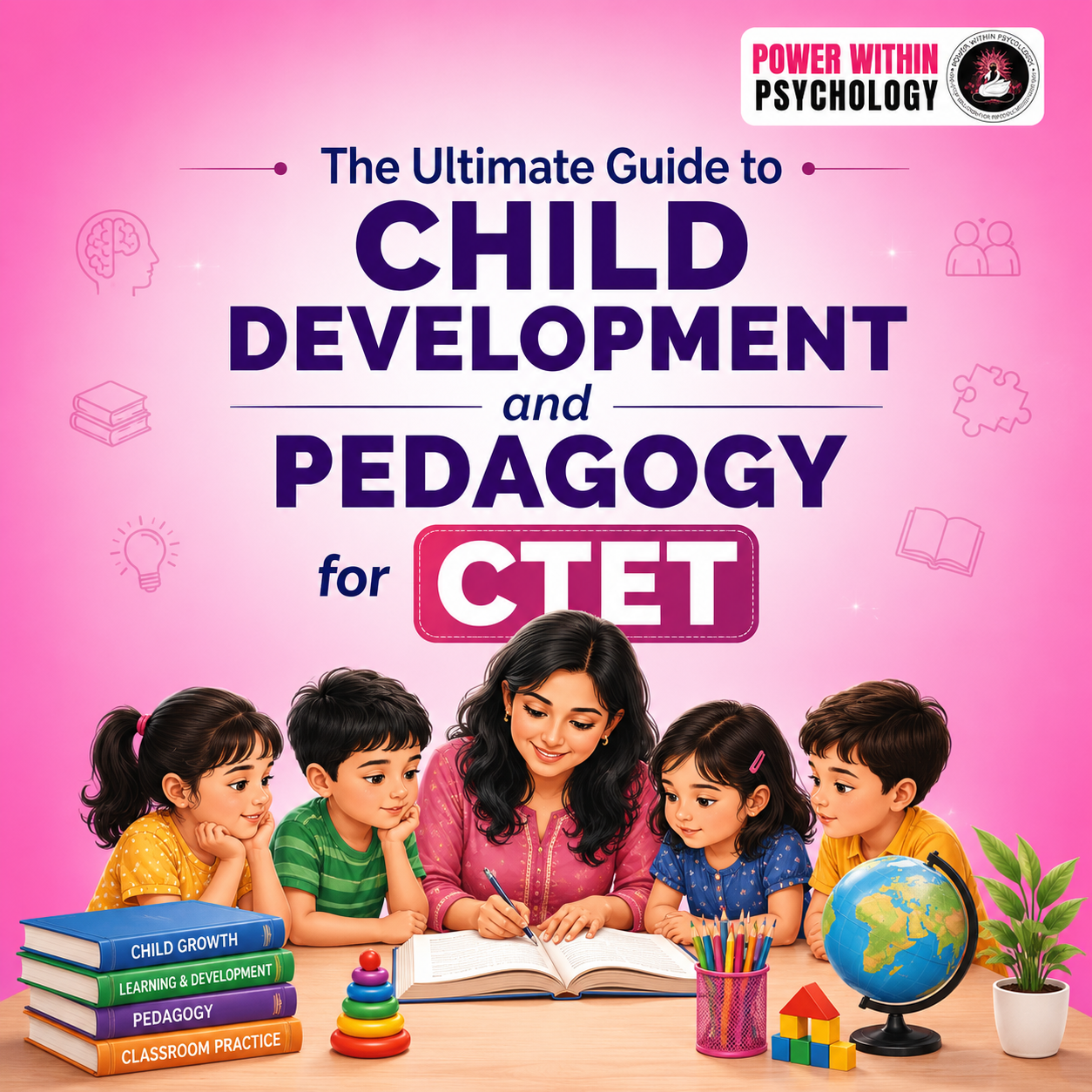
If you want to become a teacher, knowing your subject is only one part of the journey.
An effective teacher must also understand how children think, how they learn, and what teaching methods help them learn best.This is exactly what the Child Development and Pedagogy (CDP) section in CTET is designed to assess.
CDP is not just another exam subject. It is the foundation of good teaching and one of the most scoring sections in the CTET examination.
CDP Full Form
CDP = Child Development and Pedagogy
This section combines two essential areas:
- Child Development – Understanding how children grow and learn.
- Pedagogy – Understanding the methods and principles of teaching.
Together, these areas evaluate whether a candidate has the mindset and understanding required to become an effective teacher.
What is Child Development?
Child Development refers to the systematic and progressive changes that take place in children from birth through adolescence.
These changes occur in multiple areas, including:
- Physical development
- Cognitive development
- Emotional development
- Social development
- Moral development
- Language development
In simple terms, Child Development helps us understand:
- How children think
- How they learn
- How they solve problems
- How they express emotions
- How they interact with others
For teachers, this knowledge is crucial because children at different ages learn in different ways.
What is Pedagogy?
Pedagogy refers to the science, art, and practice of teaching.
It focuses on questions such as:
- How should teachers teach?
- Which teaching methods are most effective?
- How can students be motivated?
- How should learning be assessed?
- How can teachers support all learners?
In short:
Pedagogy is the study of how teaching should be planned and delivered to maximize student learning.
Difference Between Child Development and Pedagogy
| Child Development | Pedagogy |
|---|---|
| Focuses on the learner | Focuses on the teaching process |
| Explains how children grow and learn | Explains how teachers should teach |
| Based on developmental psychology | Based on instructional strategies |
| Helps understand student needs | Helps improve classroom instruction |
Why Are Child Development and Pedagogy Combined?
A teacher needs to understand both:
- How children learn (Child Development)
- How to teach effectively (Pedagogy)
For example, if a teacher knows that young children learn best through concrete experiences, they will use activities, stories, and visual aids instead of relying only on lectures.
This integration makes teaching more meaningful and effective.
What Does CTET CDP Measure?
The CDP section evaluates whether a candidate can:
- Understand child psychology
- Apply developmental theories in classroom situations
- Use child-centered teaching approaches
- Address individual differences
- Promote inclusive education
- Assess learning effectively
The emphasis is on practical application, not rote memorization.
How Does CTET Assess CDP?
Questions are usually conceptual and classroom-based.
Examples include:
- Which teaching strategy is best for a mixed-ability classroom?
- How should a teacher respond to student mistakes?
- Which theory explains moral development?
- What is the purpose of formative assessment?
The correct answer is typically the one that is most child-centered, inclusive, and educationally sound.
CTET CDP JANUARY 2026 ANYLASIS
Based on the CTET January–February 2026 exam analysis, the Child Development and Pedagogy (CDP) section was primarily conceptual and application-based, with a significant number of classroom-oriented questions. A notable trend was the inclusion of several:
- Assertion–Reasoning questions
- Classroom scenario-based questions
- Conceptual questions from educational psychology
- NEP 2020-based questions (1–2 questions)
- Theory-based questions from Piaget, Vygotsky, and Kohlberg
- Questions on inclusive education and special needs
- Assessment and pedagogy-based questions
These questions focused on conceptual clarity rather than rote memorization. Candidates frequently reported questions on cognitive development, Zone of Proximal Development (ZPD), scaffolding, moral development, child-centered learning, and competency-based education.
Overall, if your basics are strong in developmental theories, inclusive education, assessment, and NEP 2020 principles, CDP can be one of the most scoring sections in CTET.
Weightage of CDP in CTET
| CTET Paper | Questions | Marks |
|---|---|---|
| Paper 1 (Classes I–V) | 30 | 30 |
| Paper 2 (Classes VI–VIII) | 30 | 30 |
Since the section appears in both papers, mastering CDP can significantly boost your overall score.
Official CTET CDP Syllabus Overview
The official syllabus is divided into three parts:
a) Child Development 15 Questions
- Concept of development and its relationship with learning
- Principles of the development of children
- Influence of Heredity & Environment
- Socialization processes: Social world &children(Teacher, Parents, Peers)
- Piaget, Kohlberg and Vygotsky: constructs and critical perspectives
- Concepts of child-centered and progressive education
- Critical perspective of the construct of Intelligence
- Multi-Dimensional Intelligence
- Language & Thought
- Gender as a social construct; gender roles, gender-bias and educational practice
- Individual differences among learners, understanding differences based on diversity of
language, caste, gender, community, religion etc. - Distinction between Assessment for learning and assessment of learning; School-Based
Assessment, Continuous & Comprehensive Evaluation: perspective and practice - Formulating appropriate questions for assessing readiness levels of learners; for enhancing
learning and critical thinking in the classroom and for assessing learner achievement.
b) Concept of Inclusive education and understanding children with special needs
5 Questions- Addressing learners from diverse back grounds including disadvantaged and deprived
- Addressing the needs of children with learning difficulties, “impairment‟ etc.
- Addressing the Talented, Creative, Specially abled Learners
c) Learning and Pedagogy 10 Questions
- How children think and learn; how and why children„ fail‟ to achieve success in school
performance. - Basic processes of teaching and learning; children’s strategies of learning; learning as a social
activity; social context of learning. - Child as a problem solver and a “scientific investigator‟
- Alternative conceptions of learning in children, understanding children’s “errors‟ as significant
steps in the learning process. - Cognition & Emotions
- Motivation and learning
- Factors contributing to learning-personal & environmental
- How children think and learn; how and why children„ fail‟ to achieve success in school
Why CDP Is One of the Most Important CTET Sections
CDP is often considered the heart of the CTET exam because it tests your teaching aptitude.
A strong understanding of this subject helps you:
- Solve application-based questions accurately
- Develop a child-centered teaching perspective
- Perform well in both papers
- Build skills that are directly useful in real classrooms
Why is Power Within Psychology Launching a CTET CDP Course?
At Power Within Psychology (PWP), our focus has always been on making psychology simple, practical, and easy to understand. Since Child Development and Pedagogy (CDP) is deeply rooted in child psychology, developmental theories, learning processes, and educational psychology, we felt the need to create a dedicated course that helps CTET aspirants build strong conceptual clarity rather than relying on rote memorization. This is why, for the first time, PWP is bringing a comprehensive CTET CDP Course designed to make important theories and concepts easy, relatable, and exam-oriented.
To support your preparation, we will also be sharing free CTET CDP content, concept videos, and exam-related discussions on our YouTube channel. If you’re preparing for CTET, make sure to subscribe and stay connected so you don’t miss the upcoming learning resources and course updates.
Share this article by Power Within Psychology (PWP):

Discover more from Power Within Psychology | BLOGS
Subscribe to get the latest posts sent to your email.