




Table of Content
Intelligence is one of the most widely studied concepts in psychology. IQ (Intelligence Quotient) tests are commonly used to assess an individual’s cognitive abilities, including reasoning, memory, problem-solving and verbal comprehension. However, an important question remains: How accurately can an IQ test measure intelligence?
Although IQ tests provide valuable insights into cognitive functioning, they cannot capture every aspect of human intelligence or determine an individual’s overall potential. Understanding how these tests work, what their scores indicate and where their limitations lie is essential for interpreting results correctly.


What Is an IQ Test?
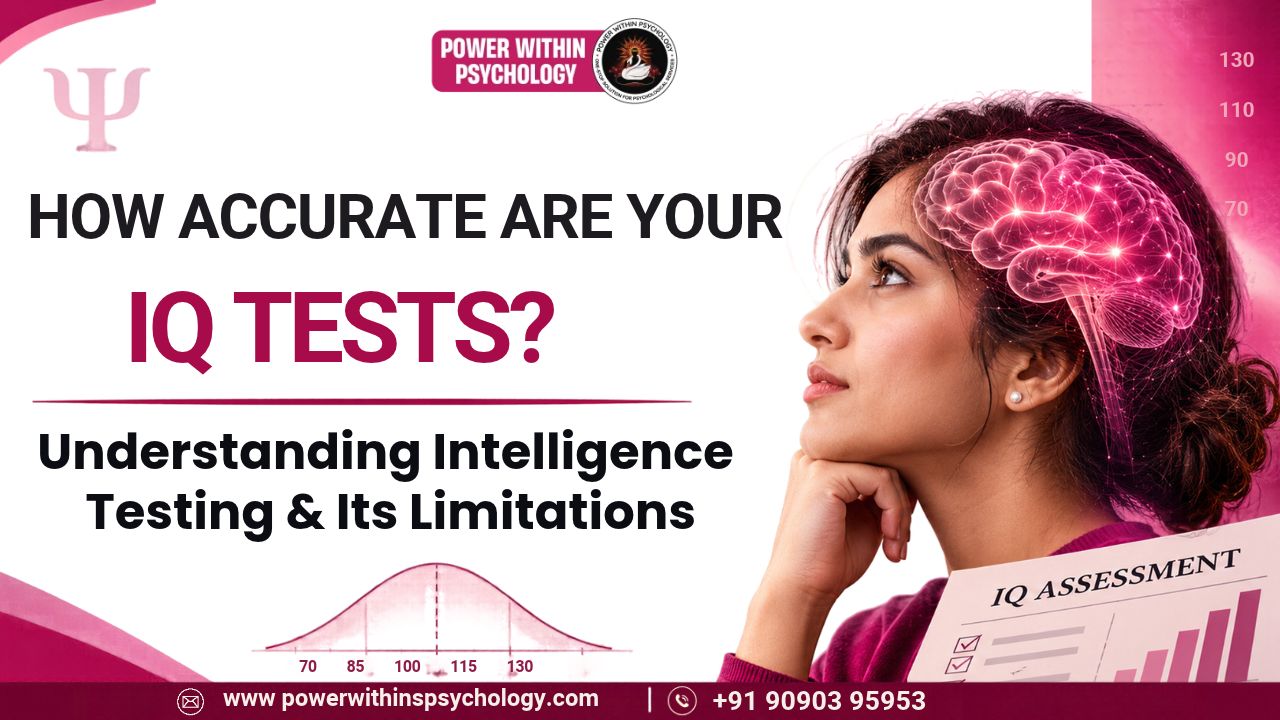
An Intelligence Quotient (IQ) test is a standardised psychological assessment designed to measure specific cognitive abilities. These tests evaluate how an individual performs on different intellectual tasks compared with people in the same age group.
IQ Score Classification
| IQ Score Range | Classification |
|---|---|
| Below 70 | Extremely Low |
| 70–79 | Borderline |
| 80–89 | Low Average |
| 90–109 | Average |
| 110–119 | High Average |
| 120–129 | Superior |
| 130 and above | Very Superior / Gifted |
Understanding IQ Score Ranges
An IQ score below 70 indicates significantly lower performance on standardised intelligence measures. However, it does not independently establish intellectual disability. Clinical diagnosis requires significant limitations in both intellectual functioning and adaptive functioning, with onset during the developmental period.
Scores between 70 and 79 are generally classified as borderline, while 80–89 represents the low-average range. Scores between 90 and 109 fall within the average range, which includes approximately half of the population.
Individuals scoring between 110 and 119 fall within the high-average range, while scores of 120–129 are generally classified as superior. An IQ score of 130 or above is often associated with very superior intellectual functioning and is approximately within the top 2% of the population. Some assessment frameworks further describe scores of 145 and above as exceptionally gifted.
Note: These classifications are approximate and may vary across intelligence tests. IQ scores should always be interpreted using the specific test’s norms and professional assessment guidelines.


How Are IQ Tests Conducted?
IQ tests are administered using standardised procedures to ensure consistency in assessment and scoring. Depending on the test, they may include:
- Verbal Comprehension: Understanding language, vocabulary and verbal reasoning.
- Working Memory: Retaining and mentally manipulating information.
- Processing Speed: Completing simple cognitive tasks accurately and efficiently.
- Perceptual Reasoning: Identifying patterns, understanding visual information and solving non-verbal problems.
- Fluid Reasoning: Solving unfamiliar problems using logical thinking.
Some well-known intelligence assessments include the Wechsler Adult Intelligence Scale (WAIS), Wechsler Intelligence Scale for Children (WISC) and Stanford-Binet Intelligence Scales.
How Accurate Are IQ Tests?
IQ tests can be reliable and scientifically useful when they are properly developed, standardised and administered by qualified professionals. However, their accuracy depends on several factors.
1. Reliability: A reliable IQ test produces reasonably consistent results when administered under comparable conditions. However, scores may vary due to fatigue, stress, distractions or differences in testing environments.
2. Validity: A valid assessment measures the cognitive abilities it claims to evaluate. Well-established IQ tests have demonstrated validity for assessing several aspects of intellectual functioning.
3. Standardisation: IQ scores are compared with a representative normative sample. Appropriate norms help ensure that an individual’s performance is interpreted in relation to people of a similar age group.
4. Testing Conditions: Sleep deprivation, anxiety, illness, motivation and unfamiliarity with the testing language can influence performance and potentially affect results.
Therefore, an IQ score should be interpreted as an estimate of cognitive functioning rather than an absolute measurement of intelligence.


Limitations of IQ Tests
Despite their scientific value, IQ tests have certain limitations that should be considered before drawing conclusions about an individual’s abilities.
- Limited Measurement: IQ tests primarily assess selected cognitive abilities and may not fully capture creativity, emotional intelligence, practical skills, social understanding or artistic abilities.
- Cultural and Linguistic Differences: Language, educational opportunities and cultural familiarity may influence performance, particularly when assessments are not appropriately adapted.
- Environmental Influences: Nutrition, socioeconomic conditions, learning opportunities and educational exposure can influence cognitive development and test performance.
- Temporary Psychological Factors: Stress, anxiety, low motivation and fatigue may affect an individual’s performance on the day of testing.
- Changing Cognitive Abilities: Cognitive development and performance can change with age, education, experience and other environmental influences.
Consequently, a single IQ score should never be used to define a person’s overall capabilities, future success or worth.
Does a High IQ Guarantee Success?
A high IQ can indicate strong performance in certain cognitive areas, but it does not guarantee academic, professional or personal success.
Factors such as emotional regulation, motivation, perseverance, communication skills, adaptability and social relationships also contribute significantly to everyday functioning and achievement.
Similarly, an individual with an average IQ may demonstrate exceptional creativity, leadership, practical intelligence or interpersonal skills. Human potential is multidimensional and cannot be reduced to a single numerical score.
Different Types of IQ Tests
Several standardised intelligence tests are used by psychologists to assess cognitive abilities across different age groups. Some widely recognised intelligence assessments include:
- Wechsler Adult Intelligence Scale (WAIS): Designed to assess intellectual abilities in adults.
- Wechsler Intelligence Scale for Children (WISC): Used to assess cognitive abilities in children, generally aged 6–16 years.
- Stanford-Binet Intelligence Scales: Measures different aspects of intelligence across a wide age range, from early childhood to adulthood.
- Raven’s Progressive Matrices: A non-verbal assessment that evaluates abstract reasoning and pattern recognition.
- Kaufman Assessment Battery for Children (KABC): Assesses cognitive processing and problem-solving abilities in children.
- Differential Ability Scales (DAS): Evaluates different cognitive and intellectual abilities in children and adolescents.
Who Should Conduct an IQ Test?
IQ tests should be administered, scored and interpreted by appropriately qualified and trained psychological professionals, following the requirements of the particular assessment and applicable professional guidelines.
Professional administration is important because the assessment involves standardised procedures, age-appropriate norms, controlled testing conditions and careful interpretation of results.
Online IQ quizzes and informal intelligence tests cannot replace a standardised psychological assessment. A professional evaluation also considers relevant developmental, educational, behavioural and environmental factors before drawing conclusions about an individual’s cognitive abilities.
Conclusion
IQ tests are valuable psychological tools for understanding specific cognitive abilities, but their accuracy should not be confused with their ability to measure every dimension of intelligence. A standardised IQ score provides useful information about an individual’s cognitive functioning at a particular point in time, not a complete picture of their potential.
Intelligence is complex, and every individual possesses different strengths and abilities. Rather than allowing a numerical score to define a person, IQ results should be used responsibly to support better understanding, learning and psychological development.
At Power Within Psychology, we believe that understanding individual differences is an important step towards recognising human potential and promoting psychological well-being.






Share this article by Power Within Psychology (PWP):

Discover more from Power Within Psychology | BLOGS
Subscribe to get the latest posts sent to your email.